
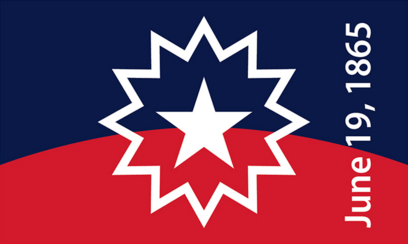
Happy Juneteenth to all. Now that it’s an official university and federal holiday (and I got to sleep in), I’ve been reading a bit more about origin, meanings, and traditions. I’ve been living in the Deep South for over a quarter century, count lots of African Americans amongst my close friends but there’s still so much more I have to learn about the culture and subcultures of that community. The thing I have learned the best is about how the middle class white culture I was raised in was simply blind to so many realities and my eyes continue to be opened to the incredibly rich social tapestry right in front of me. I shouldn’t be surprised. After all, so much of the LGBTQ world is invisible to the straight world even when it’s right in front of them. American history, arts, and culture are so thoroughly intertwined with African American history, arts, and culture that this current backlash against DEI, minority perspectives, and ‘wokeism’ (whatever that’s supposed to mean) is a classic example of cutting off nose. It’s an attempt to go back to the monolithic Eurocentric culture invented out of media images of post World War II America that was entirely fantasy to begin with. Personally, I’m moving forward and love learning more and more about different ways of living and being. As I’m now in the last third of life, I’m starting the transition from someone whose main focus iss to do things in the world to someone whose main focus is to be in the world. Perhaps that’s wisdom.

I need to say a thing or two about the Tony award and what’s going on there. I haven’t made a big deal of it because I’m kind of a Tony winner and kind of not. The most accurate way of putting it is that I’m a principal in a company that invested in Stereophonic, the show that won this year’s Tony for Best Play. Our investment which wasn’t huge, was bundled together with other groups investments by a New York producer and became a single investment unit in the property. That producer was one of a number of production organizations that raised the capital to get the show on. Under the rules of the American Theater Wing, Tonys for producers are awarded only to the individuals/organizations at Co-producer level or above (the level of the New York producer who bundled our investment) so she is the one that gets the statuette. We don’t. So if you were expecting to see a Tony sitting on my mantle the next time you came over, you will be disappointed.
These rules are relatively new and to understand them, we need to delve a bit into Broadway history. Modern Broadway got its start about 1900 with the completion of the basic Manhattan subway lines complete with a large interchange at Times Square in midtown. New York theaters were mainly much further downtown around 14th street at the time. George M. Cohan saw the potential in the numbers of people now filing through Midtown on a routine basis and built his theater there. Other entrepreneurs such as David Belasco and Florenz Ziegfeld followed suit and over the next three decades, the Times Square area (where 7th Avenue crosses Broadway) became the epicenter of American theater.

Broadway was well established when American musical theater as we know it developed around World War II. The revolutionary fully integrated musical that changed the artform was Oklahoma! in 1943 (although Showboat came close in 1927). It launched a roughly forty year run of a production model where a production company, typically dominated by a single personality with a deep background in theater (David Merrick, Hal Prince, Kermit Bloomgarden) would raise money from a small coterie of wealthy investors to put on the show and, if the show was successful, those investors were paid back and participated in profit sharing. The Tonys for Best Play or Musical, which began in 1947, were awarded to these easily identified individuals.
In the 1970s and 1980s, the economics shifted. The budget for the original production of Oklahoma! in 1943 was $83,000 (about $1.5 million today – expensive but only about a fifth of what it takes to capitalize a musical these days). Improvements in stage technology, union costs, theater renovations etc. drove up production costs regularly and the one person production shops were no longer viable and were replaced by corporate entities of various stripes. The number of producers needed to raise the capital to bring in a big show went up exponentially. The people behind all of these entities wanted to be rewarded if their show won a Tony and more and more were handed out. With the popularity of EGOT status, people not of theater backgrounds who could never hope to win a Tony for artistic excellence would put money into a likely contender for Best Play or Musical so they could win one for producing.
The American Theater Wing, which awards the Tonys, decided a few years ago to ratchet down and now states that only those of ‘co-producer’ status or above are eligible for the award. What does it take to become a ‘co-producer’? Well, that really depends on the show, it’s budget and how desperate they are for financing. Our group had co-producer status last year on the play Fat Ham (which did not win) as they were having more difficulties raising capital than Stereophonic. We haven’t yet chosen what investment to make this coming season. If you’re interested in learning more about this or joining the group (which benefits Central Alabama Theater – that’s where returns are going, not my bank account), talk to me. The bigger the investment we can make, the more likely we’re going to hit that co-producer mark and then at least CAT will get a statuette and we’ll all get a photo op.
Bottom line – I am a low down the totem pole investor/producer of a Tony award winning play. So I’m sort of a Tony winner although you won’t find me listed on the website and I don’t get a statuette.
 Life, The Universe, and Everything