
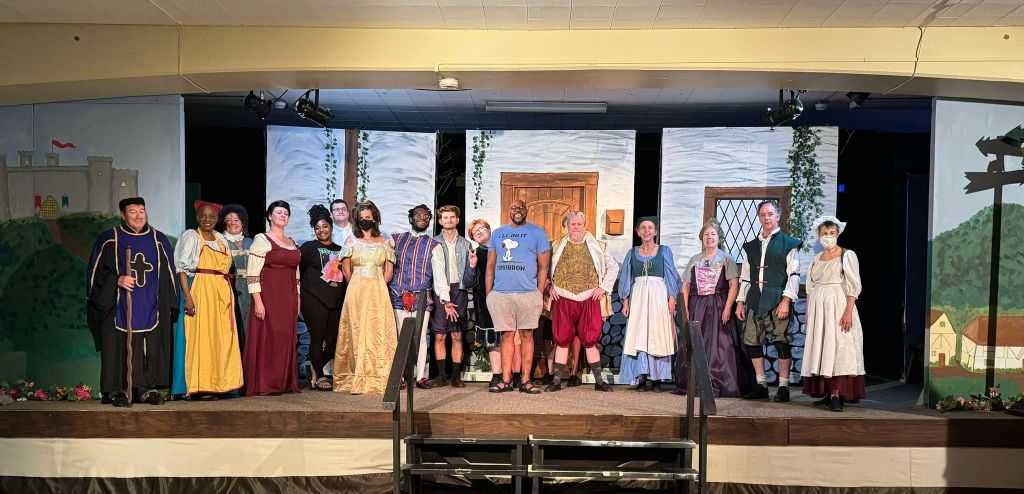
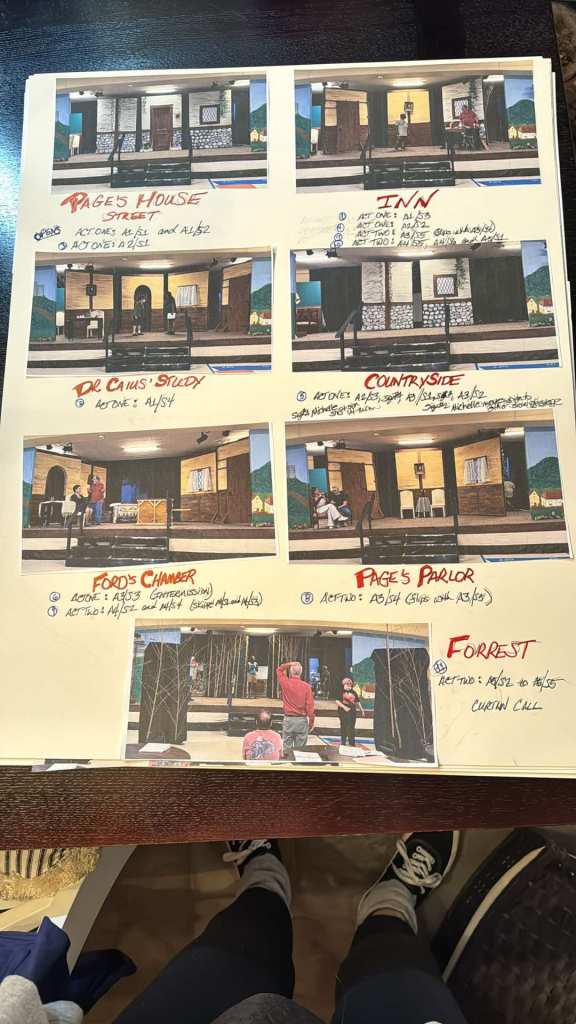
I napped today. I don’t usually like to nap because when I wake up, I can’t get myself going again at the speed I feel I need to perform. But a nap was a bit of a necessity as this is the one day I have away from The Merry Wives of Windsor for a week. We teched the show yesterday. (Due to the iffy condition of the lighting system, lighting cues are minimal and sound cues are mainly Dowland songs and lute music to cover changes). Now we have three dresses in which to polish the whole thing up before presenting it for public consumption. We had a dress parade and the costumes look great and fit well with the cartoony set so I’m really quite pleased with the whole physical production. Now I just have to convince the cast that telling the story is far more important than getting their lines exactly right.
I’ve learned a lot about directing from life over the last few decades. When I began directing theater in my teens and twenties, I spent most of my time focusing on what was wrong and trying to fix it. Life lessons have helped me, as I have returned to directing in my later middle age, realize that I need to focus much more on what is right and help to elevate from a position of encouragement and allow each actor or designer or technician to become the best they can be by helping remove the roadblocks that are in their way, whether those are unfamiliar language, lack of resources, or trying to wrap their heads around situations with which they have no real life experience. I have come to recognize that with community theater, it’s the first word that is often the more important. Each show is an opportunity to bring people together, to get them to trust each other, to get them to work together in a positive environment to create something they could not create on their own.
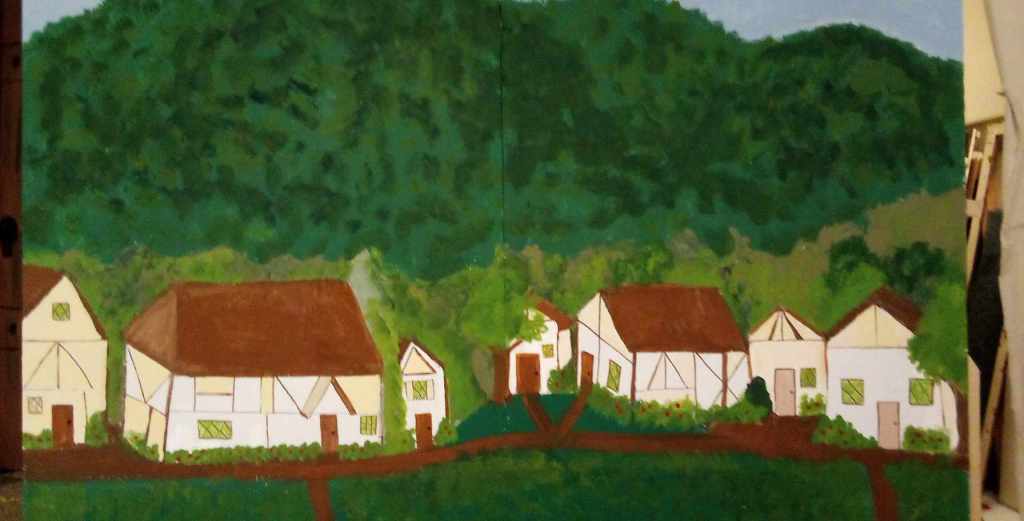
The most important character to me, in The Merry Wives of Windsor, is not Falstaff, who is usually regarded as the star of the show. It’s the town of Windsor. It’s this small community in the shadow of Windsor castle with its aristocrats, its professionals, its menials who all live and work together, tumbling in and out of each others lives. It’s very much an ensemble show. Some have more lines or stage time than others but each part helps build and enrich this world of some four hundred years ago that we’re still interested enough to recreate and put on stage and laugh at. Some of the jokes are timeless. Some are definitely dated. But when an ensemble of performers commit to each other, they can bring a town and its doings to life.
I have a cast of eighteen ranging from age 11 to age 85, of disparate backgrounds, abilities, and experiences. If I have done my job properly, they will enact a story that will hold a 2024 audience for roughly two and a quarter hours. That’s what theater is about at its core – the telling of a story. We tell stories for all sorts of reasons but ultimately stories are what connect us all. To other cultures. To generations past. To generations yet to come. IF we are all threads in the pattern, stories are the laying of the warp and the weft that allow the pattern to come into being. I am hoping that my cast and crew will come away from the experiences of these six weeks with positive experiences, new connections, and new stories to tell about the sometimes exciting and sometimes maddening process of creating a new show.
If you get theater people together, especially if a couple of drinks are involved, the stories begin. We talk about outrageous personalities we have worked with in our time. We relate the on stage disasters of malfunctioning sets, missing props. wardrobe malfunctions and all of the other things that happen during life performance, most of which the audience is blissfully unaware. We talk about out of town performance dates and the odd conditions we find in unfamiliar venues. We speak our own lingo of spikes and front of house and ghost lights which is incomprehensible to the uninitiated. Some stories come and go. Some become local theatrical legend, like the biker bar brawl that spilled onto the stage during a Theater Downtown performance of many years ago or a local actresses trip and sliding off the stage during a live holiday television broadcast.
Queen Elizabeth I, enamored of Falstaff from the Henry IV plays, demanded a play in which she could see Falstaff in love. Shakespeare, knowing that disappointing the sovereign was not a good idea, obliged. Legend has it the show was written, rehearsed and performed at court in a roughly two week period. And four hundred plus years later, in the basement of a Methodist church in Birmingham, Alabama, the same characters and same situations will be enacted again. And several centuries from now, another generation will do the same somewhere else as the human condition really doesn’t change. I think Shakespeare would be pleased.
You too can experience the magic – http://btpelumc.booktix.com
 Life, The Universe, and Everything