

Dateline – Iguazu National Park
If Rio was all about salt water, today was all about fresh water. I am ensconced in the pink palace known as the Hotel de Cataratas sitting on the edge of the gorge through which the Iguazu river runs after hurtling itself over the famed Iguazu falls. I had gotten a glimpse of them last night in the moonlight but hadn’t had a chance to truly explore them. I know the basic facts – about one and a half times as tall as Niagara. An average of 400,000 gallons a second (they’re a bit low at the moment due to some draught and only doing about 275,000 gallons a second), anywhere between 150 and 300 individual falls depending on the rainfall and flood stage of the river. Global warming has caused them to see-saw back and forth. A year ago there were torrential rains that raised the river and falls to a level that all of the walkways that create access to the viewpoints washed away. This year it’s running low. But nothing can quite make you understand them until you actually see them up close and personal.
These falls weren’t as famous as Victoria Falls in Africa or Niagara until relatively recently. They’re remote. There wasn’t much of a tourist infrastructure. Then Hollywood came calling. The film ‘The Mission’ with its indelible image of the crucified Jesuit priest being launched over Iguazu falls by an unfriendly indigenous tribe brought international attention. (Some years later they were also used in Indiana Jones and the Kingdom of the Crystal Skull). Most of the area is national park – both on the Argentina and the Brazil sides and kept fairly pristine. The area outside where the city of Foz do Iguacu is located is rapidly becoming the South American equivalent of Pigeon Forge with water slide parks, wax museums, visits to animatronic dinosaurs and, for those whose tastes run to other things, a huge shopping mall on the Paraguay side of the triple border. (After a disastrous war in the 19th century, borders were shifted around to allow Paraguay river access so it could ship its products easily to the ocean for export). The bus crossed a bit of no mans land on our trip from the Brazilian to the Argentine side of the falls where all three borders come together. I’m trying to decide if I can tick Paraguay off my countries visited list for that.

We got up early and after a different, although very similar breakfast buffet, were on the bus for the Argentine side of the falls (better pedestrian access). The bridge across the river is a dozen or so miles downstream of the falls so it took a while to make our way down there, get through customs, and then make our way back up to the falls on the opposite bank. Once there, a walk through the jungle (lots of birds and butterflies but all the mammals appear to have been sleeping with the exception of an enterprising tribe of coatimundis who were quite deft at stealing knapsacks if left unattended), a ride for a few miles on a quaint little amusement park train, and then about a half mile walk across a raised metal boardwalk taking you right out over various river channels to the top of the main falls pouring two hundred and some feet down over a lip of basalt. The air was wet with back spray, the platform was crowded with tourists from all over the world, and it was unforgettable to be that close to such a wonder of nature. Then reverse the process back to the main gates of the park for lunch.
The jungle is incredibly thick and difficult to see more than about 50-100 feet off the path before all is blocked by trees, shrubs, creepers and all sorts of vegetation. There may have been a dozen jaguars, a dance troupe of capybaras, and a tapir all within 75 feet and I would not have seen them. Only the monkeys and the coatis seem to have made peace with the human invasion and decided that tourists can be good sources of food, no matter how many ‘don’t feed the animals’ signs are placed around. The picnic areas are all within large cages to try and keep them out so that families can have their sandwiches in piece without an aggressive coati jumping on the table and running away with sister’s peanut butter and jelly and scratching her should she happen to object. Our lunch was at an Argentine barbecue buffet. The meat was good, if a bit under cooked. As we walked in the in house musician, playing a combo of harp and some sort of steel drums was playing ‘Don’t Cry for Me, Argentina’. And I thought Evita was still verboten in the country.
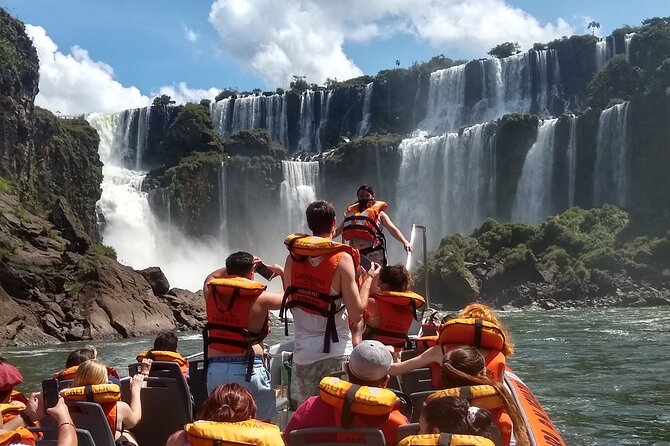
After lunch, repeat bus ride back to the Brazilian side and a choice of either a helicopter ride over the falls or a boat ride up to the base. I’m not scared of a lot. I’ve stood at the edge of cliffs, walked out on glass suspended walkways over canyons, ridden every roller coaster I’ve come across, and peered into the caldera of an active volcano. But I am exceedingly unnerved in a small plane or helicopter. I scrunch my eyes shut and hope it lands soon. Therefore I opted for the boat. To get down to the river from the top of the canyon required a ride in a large open truck thing, a switch to a smaller jeep thing for the steeper part of the descent, an incline elevator, and then you’re at river level. Put on your life jacket and off you go in a thirty passenger zodiac speed boat with a crew of two Brazilians determined to make sure you will feel every bump in the whitewater and show off for their friends driving the other boats. Up the whitewater to the base of the falls (not the main one, that would swamp an open boat immediately should you get under it) and in and out of a few of the minor falls ensuring everyone gets good and soaked. As the weather was a pleasant low 80s without humidity and the river water a cool, but not cold temperature, it was all great fun with lots of shrieks as the waterfall descended on our heads again.

Back up the hill to the bus to get back to the hotel to dry out and change for dinner. Dinner was at a rather unusual restaurant – Casa do Chef in which a young chef from the area (who used to be the executive chef at this hotel) has built a dining room where groups can learn all about Brazilian food and history together. Starting with appetizers made solely according to recipes handed down in indigenous societies, and through four more courses, become more varied as the Portuguese brought new ingredients from Europe, Africans brought their foods and cooking techniques, and then 19th and 20th centuries economies of scale and industrial processing changed everything. The meal was excellent. I particularly liked an indigenous preparation of roast duck with casava.
Tommy would have been all about that dinner, peppering the chef with questions and taking notes so he could try some new things at home. He would have been indifferent to the falls. He was not a sightseeing person. He wanted to experience different cultures and ways of living. Steve would have been all about the speedboat ride, whooping and catcalling at the top of his lungs and shrieking like crazy every time we went under a waterfall. He would have eaten portions of the dinner, refused other courses on principle (nothing with seafood ever), and complained incessantly about the length of the walks. How did I end up with two so very different men? I miss them both. Someday I’ll find the right travel companion.
 Life, The Universe, and Everything