
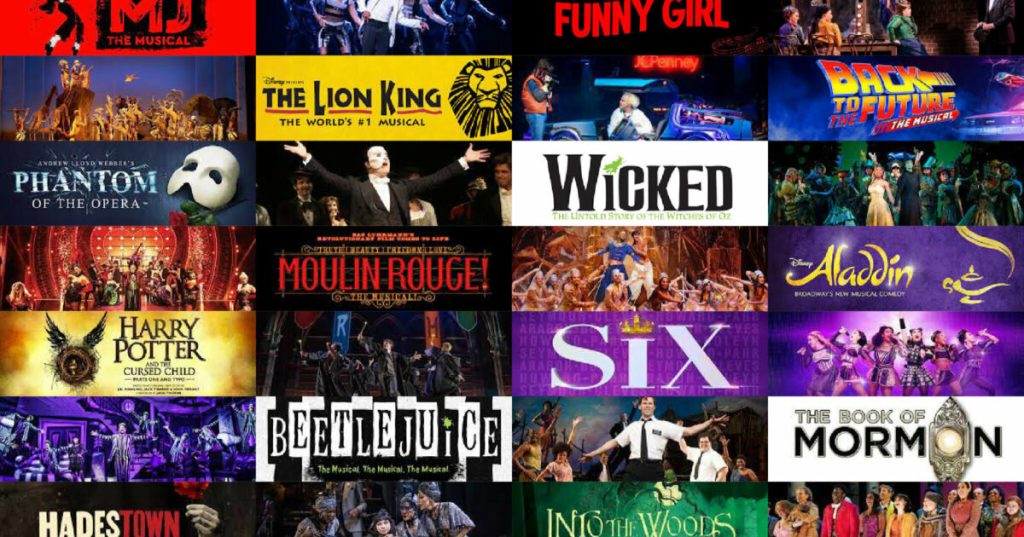
I’ve been living in a world of musical theater over the last week or so. Last weekend, I attended Terrific New Theatre‘s opening production in their brand new space (for which I bought them one of the dressing rooms in memoriam Tommy) – Sunday in the Park with George. I also saw a performance of the new national tour of the revival production of Chicago as two friends were on stage – Brent Crawford Mauldin as the band leader and Drew Fillinger as Mary Sunshine. I am boning up on my lines and lyrics for Little Women as we start the tech process on Sunday (we’re in good shape and I’m looking forward to seeing everyone in costume and makeup and under stage light). I’ve been listening to the OBC recording of Ragtime as I hadn’t had it in rotation for a while and the recent Encores production in New York, of which I saw a few clips, reminded me of just how good it is. Tomorrow, I venture out to the IMAX to see the new film version of Wicked which all the theatre kids have been raving about.
A lot of people who know me through other walks of life think that my preoccupation with music theater art forms is something between eccentric and frivolous but as we continue to descend into uncertain political times, I am constantly reminded as to how much these works of art have to teach us. The good shows that get revived over and over have very deep themes that hold up a mirror to the audience that views them and , even though they may not completely understand what they are seeing or being told, there’s something subconscious that lingers after the final curtain comes down and stays with them.
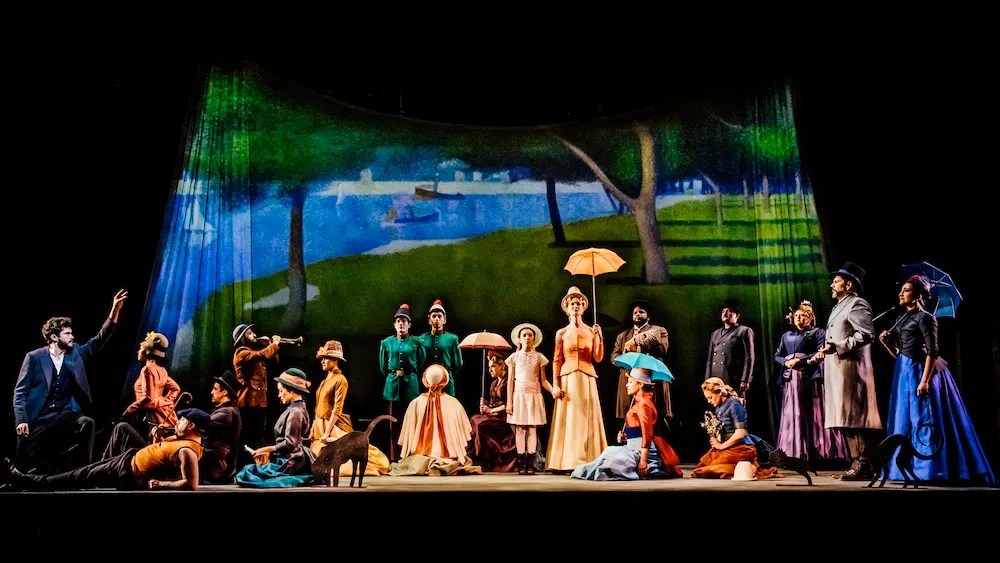
Let’s just take the ones that have entered my life this past week. Sunday in the Park with George is probably one of the lesser known masterpieces of the American musical cannon as it’s just not done as often as it should be. The music is difficult and requires actors with a high degree of musicianship. As the show (at least the first act) is about the creation of Seurat’s Sunday Afternoon on the Istand of La Grande Jatte, there are very specific technical requirements so that the audience can see the famous painting come to life as tableau vivant. But what is the show really about? It is about creation. It is about the need for change. It is about how we define our legacies. Complicated philosophical subjects to be sure. A production at this time of uncertainty and change outside of any of our control brings all this to the front. Late in the second act, a contemporary artist, George (who may or may not be Seurat’s great grandson) meets with his great grandmother who is the principal figure in the painting and they sing a duet ‘Move On’. It contains the following lyric which I always find myself referring to when I am uncertain. ‘I chose and my world was shaken. So what? The choice may have been mistaken. The choosing was not. You have to move on.’ One could easily apply this to the recent election.
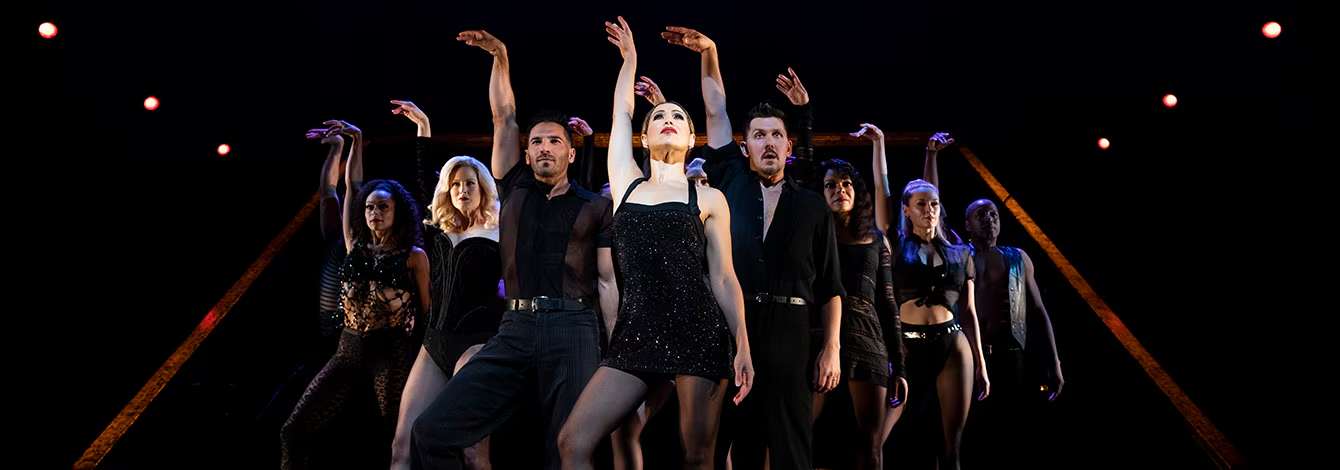
‘Chicago’ is a very different show with a very different message. When it premiered in 1975 in a brilliant Bob Fosse staging with Gwen Verdon, Chita Rivera and Jerry Orbach in the principal roles, it was successful, but not a phenomenon. It had the misfortune to open opposite another show, A Chorus Line, which helped revolutionize the direction of musical theater. Fosse’s concept was to use classic vaudeville tropes to tell the cynical story of Roxie Hart, the murderess who manipulates the system to get away with it. I’m old enough to have seen the very last bus and truck tour of the original production and I still love the colorful circuslike atmosphere of that original staging. The original production left a lot of people cold as there’s no one to root for. Everyone is equally corrupt and unpleasant. Encores brought the show back in the mid 90s in a simple staging, very sleek and black and white, overseen by Ann Reinking, Fosse’s muse. This version was a sensation, transferred to Broadway, and is still running nearly thirty years later. I think this was a case of the audience catching up with the show. Between the time of the original production and the time of the revival, we were subject to the OJ Simpson trial and that opened a lot of eyes to the sordid intersection of criminal law and showbiz. Now, of course, we realize that most of our major institutions are corrupt and spin is everything so Chicago simply affirms our current world view.
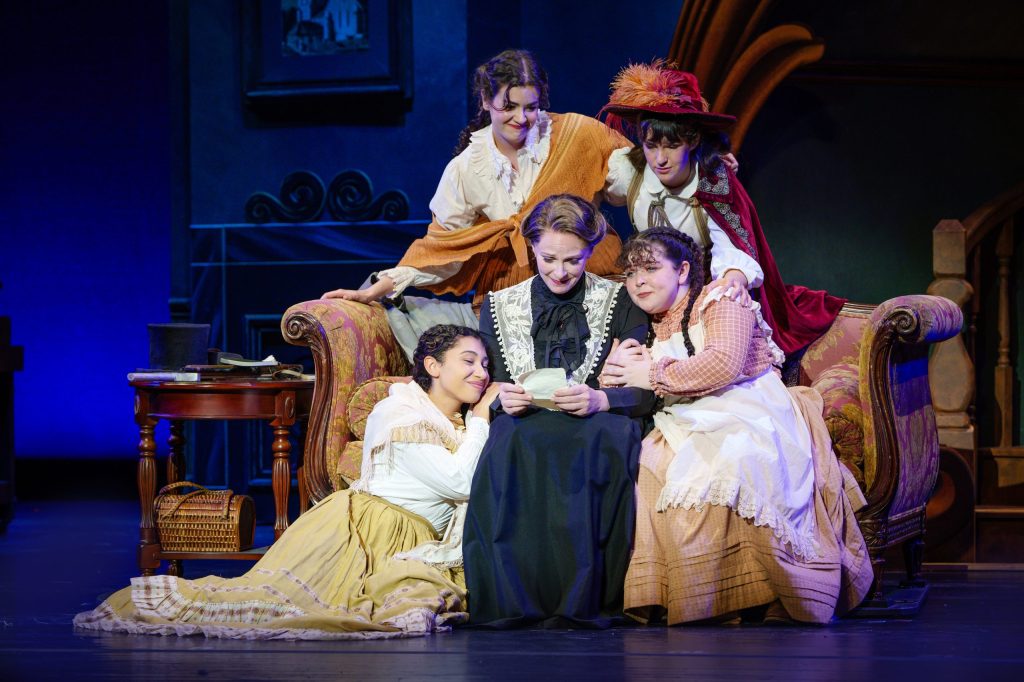
Little Women is a modern adaptation of Louisa May Alcott’s classic novel of the 19th century March family. With this book, she more or less invented Young Adult fiction, helping define a literature with themes appropriate for older children and adolescents. I had never read the book (until last month when I listened to the unabridged audio in the car as part of my research for my role) nor seen any of the multiple film or stage adaptations so I approached the material with relatively fresh eyes. What impressed me the most was how far ahead of the curve Ms. Alcott was in defining the lives and roles of women outside of the usual strictures of Victorian living. Jo, who has been a role model for countless girls over the years, in dress and behavior is what we might refer to today as non-binary and very much takes her life and decisions into her own hands. The men in the story are very much subservient to the lives and needs of the four March girls and their beloved Marmee. The show takes a long and somewhat complex story and boils it down to just over two hours and ten characters. And we see both the girls and the adult women they become. It really is an excellent example of the craft of adapting literary source material to the musical stage. The hardest element of a musical is not the music and not the lyrics. It’s the structure and style of the book. It’s so difficult that there are very few good musical book writers out there.
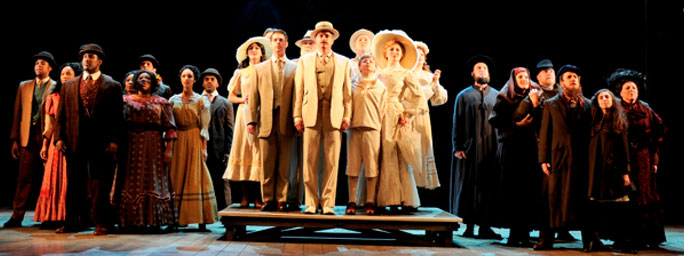
Ragtime is about America. It tells the story of the birth of modern America through several families whose lives intertwine in the first decade of the 20th century. There are the traditional WASPs. There are the African Americans. And there are the recently arrived Eastern European Immigrants. In a brilliant opening number, these three populations, eye each other suspiciously, circle around each other, and sing of their lives, traditional Western, African-American, and Eastern European/Jewish musical influences melding together to create the musical form of Ragtime which becomes a metaphor for the nation entering a new century as a world power. One of the first rules of musical theater is that you have roughly 10-15 minutes to introduce the audience to the musical, visual, and stylistic language that will govern the evening. If you can successfully do that, the audience will follow you to the end of the show. If you fail at this task, they’ll start looking at their watches half way through the first act and a number will drift away at intermission and, no matter how good your second act is, the show still won’t land. Ragtime succeeds brilliantly and that opening number gets us launched on a sprawling canvas with dozens of characters but we never get lost or cease to care. Ragtime is another show that speaks to the moment we find ourselves in, making the case that our varied cultures are all equally important in creating who we are and where we are going. Anti minority and anti immigrant sentiment may bubble up but they cannot be separated from the fabric of society without destroying it.
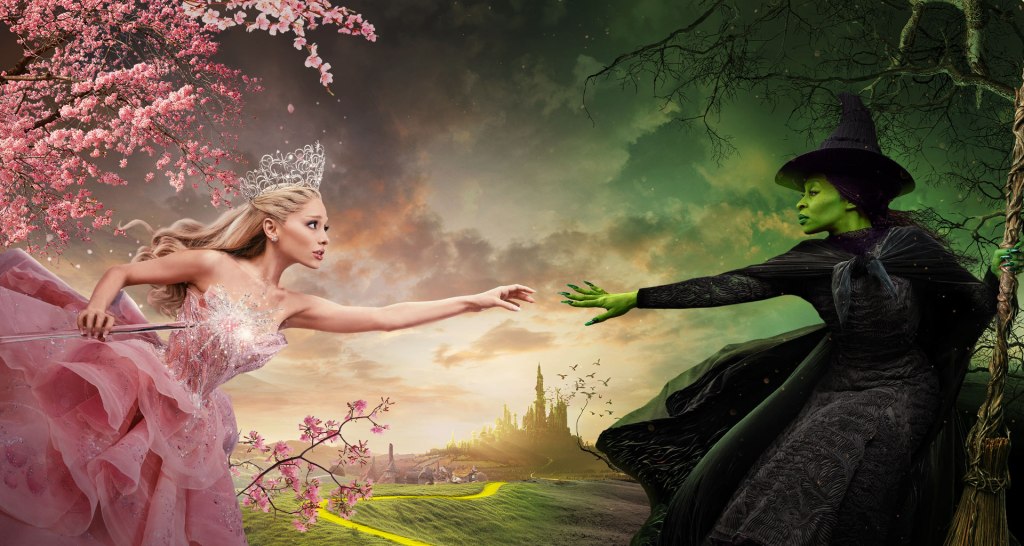
I haven’t seen Wicked yet. I’ll see it tomorrow. I have seen the original stage production several times. (Tommy and I saw the original cast in 2003 on our first trip to New York together). It’s not my favorite show. I think it has book problems, trying to stuff far too much plot into too short a time (especially in the second act – the two part long running time of the movie will likely solve that issue). I’m also not overly keen on the score as it does not appear to hang together all of a piece. It’s stylistically all over the map. But yet again, the story of strong woman standing up against a weak male leader who is trying to cover up his failings by rousing the populace against a harmless minority has a few parallels to the moment in which we find ourselves. I wonder if the hordes at the multiplex will understand that? Perhaps not on the surface but again, when you add music to storytelling, it goes through different brain centers and gets processed in ways that lead to alterations in consciousness. Perhaps people will begin to alter their behavior unconsciously for good.
Thus endeth today’s lesson in history of the American Musical Theater.
Get up. Get dressed. Go out. Do good. (Now available in T-shirt form).
 Life, The Universe, and Everything