
And this month’s viral crud remains the gift that keeps on giving. I thought I was over it on Saturday, but it came roaring back on Sunday evening, this time settling in my lungs, bringing a cough that makes me sound like a seal with the croup, and grossly interrupting my ability to sleep as enormous quantities of phlegm have been coming up the last few nights. It seems to have quieted a little tonight and I hope it’s under control by Friday when I have to get on a plane and head for Seattle. Traveling when under the weather is no fun. I have just swallowed a large dose of NyQuil and I hope it begins to work its magic over the next hour or so. If this essay degenerates into something along the lines of hhhrjjfhriet, it’s either Edward the polter-cat walking across the keyboard or it’s my brain sinking into a world of soporifics and antitussives.
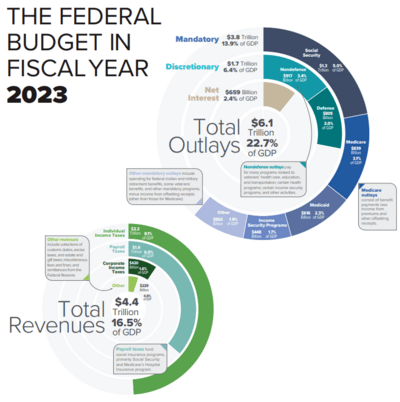
There’s been so much yelling and screaming about the budget across social media in recent days, so I decided to do some looking at the budget for the most recently completed year 10/23-9/24 to see if I could find some real numbers. Total expenditures for the year were $6.1 trillion dollars. They fall into a couple of basic buckets: social security payments ($1.3 trillion). Medicare payments ($839 billion). Defense spending ($805 billion). Interest on the national debt ($659 billion). Federal contributions to Medicaid payments ($616 billion). Income security (SNAP, SSI, Unemployment etc) ($448 billion). Veteran affairs ($301 billion). Other mandatory spending ($217 billion) and other discretionary spending (pretty much everything we regard the federal government as doing ($917 billion). Elon and the muskrats are pretty much only galumphing through this last category but it only accounts for about 15% of total outlays so pretty much everything they’re up to is ‘fraud theater’ and will make minimal impact on federal spending. We could fire every single person who receives a federal paycheck and we would save maybe 25 billion, the size of the civilian payroll, which is about 4% of the total budget. It’s not where the big money is. The size of the federal bureaucracy is actually somewhat smaller than it was forty or fifty years ago and that’s with a significant increase in population.

The only way to really reduce expenditures is going to be slashing social security, health programs (Medicare/Medicaid/Veteran’s Affairs) , and Department of Defense. Social security is the biggest bucket. Much is being made of millions of improper payments being made (although most of the evidence for this seems to come from the muskrats inability to read federal spreadsheets). There are not 20 million centenarians currently receiving social security benefits, but something under 10,000 which is in line with current census statistics. Cutting existing benefits will be met by howls of outrage from all quarters. They can attempt to cut future benefits by raising the age at which people can collect. Or they can reduce the size of the population which can collect by ensuring that life expectancy declines.
This may be the ultimate playbook here. Life expectancy isn’t particularly great in the US these days, especially as compared to other advanced countries (It’s about 78 where most of Europe is over 82). But it’s not an even distribution. Some subpopulations live much shorter lives than others. Our current elders, mainly the silent generation born during the time of the Depression and World War II, are blowing actuarial tables out of the water. There’s a lot of thought that this is due to what is known as the semi-starved rat phenomenon. It was originally described in rats but has been observed in all sorts of species since. If you calorie restrict the young, you extend life span (likely due to the creation of efficiencies of metabolism). As a generation, they were unable to glut as children and that has led to many of them living healthy lives into their late 80s and 90s. Younger generations aren’t likely to get that kick. The longer the life, the more social security payments. Therefore, choosing policies that prevent people from living healthy into their later decades leads to improved financial balances. The war on smoking, for instance, which took the percentage of adult smokers from about 65% to 15% over the last sixty years has created a much larger elder population leading to increased costs to social security and health programs.
So are we trying to create a two tiered society, a sort of split between the gentry who are given access to health care and long life and the mob who will be accorded a Hobbesian existence – nasty, brutish and short? I wouldn’t put that past the minds that are conceiving of some of our current excesses. Our current health care industry mess, which consumes 18% of our GDP, with the major funder being the federal government, is a beast. No other country spends more than 11% of GDP and the majority get better results than we do and do it without significant costs to their citizenry. We have a problem. The biggest issue is our inability to come to grips with the difference between acute and chronic disease. When Medicare was put in place, sixty years ago (at a cost of $2 billion – about $12 billion in current dollars), it was designed to allow the post employed access to health care for their acute health needs – infectious disease, injuries and the like. There was no particular thought as to the management of chronic disease. People died of these issues and did not survive to develop and require long term treatment and repeat hospitalization for such issues as congestive heart disease, chronic kidney disease, diabetes, and chronic obstructive pulmonary disease.
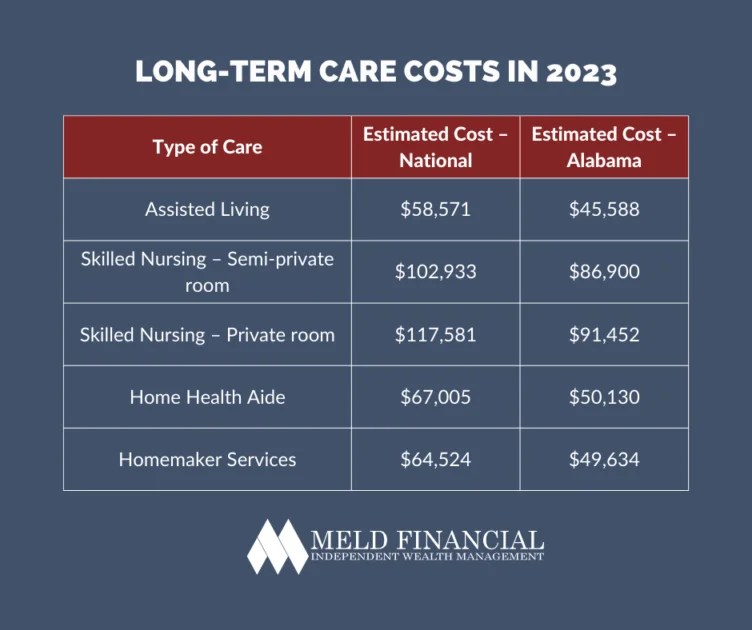
We now have the abilities to keep a significant population alive with long term expensive treatments. This is not only the elder population but also children born with significant special needs, people with major genetic anomalies, and people with sheer bad luck who become majorly disabled due to misadventure. The prevalence of significant disability in the population has increased over the last sixty years from about 2% to 13% and supporting that population costs a lot of money in terms of medical care, housing, and other maintenance. I’m not advocating any particular policies here, just pointing out what is. If we take Alabama as an exemplar, last years general fund spending was roughly 14 billion. One dollar in seven went to Medicaid long term care spending. This is not atypical for most states where somewhere between 12 and 18% of state discretionary funds are spent on long term care. And, in general federal matching funds are four times what the state spends.
If we are willing to blow up our health care industry and replace it with a true not for profit health care system, we could go a long way towards getting rid of budget deficits for the next century or so. It won’t happen. Far too many of our oligarchs are getting way too wealthy off of the system as is and they have no interest in disturbing their profit centers. We will, therefore continue to have an unwieldy, under performing system that will aggravate everyone who either works within it or tries to use it. No one is happy. Our new secretary of HHS has a couple of good ideas (removing direct to consumer prescription drug advertising, really looking at the nutritional content of manufactured foods) and a whole lot of bad ones. (Work camps for children and adolescents with mental health issues, trashing of vaccine therapy). I just hope that we aren’t going to enter a time of culling of the population by refusing to be kind to our friends and neighbors, allowing them the tools they need to live.
 Life, The Universe, and Everything