

I survived birthday weekend which included four performances of Second Samuel, a trip to the Birmingham Jefferson County Civic Center to see the touring company of Beetlejuice – the musical (enjoyable, but not good material. At the end, I only had one word in my brain – Why?) One group of friends took me to brunch, another group of friends took me to dinner, the family called, and I had something approaching a thousand well wishes on various social media platforms. I am busy reading and responding to them all it. It may take several more days to complete the task.
I secretly love social media birthday rituals. Everyone emerges on that day to leave a quick greeting and then vanishes again and the result is, at least at my age, a cross section of the intricate tapestry of life. The prize for longest acquaintance of course goes to my father who has witnessed all 63 years on some level, but I also heard from my childhood best friend whom I met when I was three, other neighbohood kids, middle school and high school classmates, people I crossed paths with at Stanford, at U of W School of Medicine, in the Seattle of the 80s, the Sacramento of the 90s, patients, families of former patients colleagues, and all of the endearing oddballs that make up the core of my life whom I collectively refer to as Bohemian Birmingham. There are well known opera singers, Broadway names, semi-famous authors, clergy, physicians, automotive mechanics, and the woman who used to work behind the counter at my dry cleaners. When I see my past unspooling in that way, I almost feel that maybe, just maybe, I’ve made some sort of positive difference in the world and that’s all any of us can really do.
I’m not sure what positive difference the latest series of journal entry essays are going to have on anything. I haven’t figured out if they amount to anything yet or if they’re just so much ephemera which will eventually disappear amongst the forgotten bits and bytes of random storage. The Covid writings, as they had singular focus, hold together. Attempting to create some sort of coherence out of the collective insanity roiling the top levels of our society just seems like a fools errand and way too diffuse to tie up in a neat little package. Perhaps I’ll repurpose some of it in someway. I just write what my publisher tells me he needs…

Most of the noise this past weekend in regards to the news cycle is about the flagrant disregard of the emoulements clause of the constitiution and the gift of a garishly over decoraded 747 by the Qataris to the president. I’m not overly disturbed as the object in question appears to be the world’s gaudiest white elephant gift. To bring it up to the standards required for the executive jet would require about a decade and billions of dollars in retrofitting and upgrades. It has no practical purpose other than being a shiny new toy and even Trump is unlikely to use it much once he again becomes a private citizen and responsible for flight costs. (No, I don’t think he’s going to be god-emperor for life…)
I have been much more concerned about the news leaking out on the health front (and I am not referring to the nation’s highest ranking health officer taking a bathe with his grandchildren in what amounts to an open sewer – if he wishes to find out the realities of bacteria, let him. I just hope he’s the one who gets sick and not the kids). I am referring to the information coming out about the massive house budget bill which is intended to formalize cuts so that the first term Trump tax cuts to the fabulously wealthy can be extended.
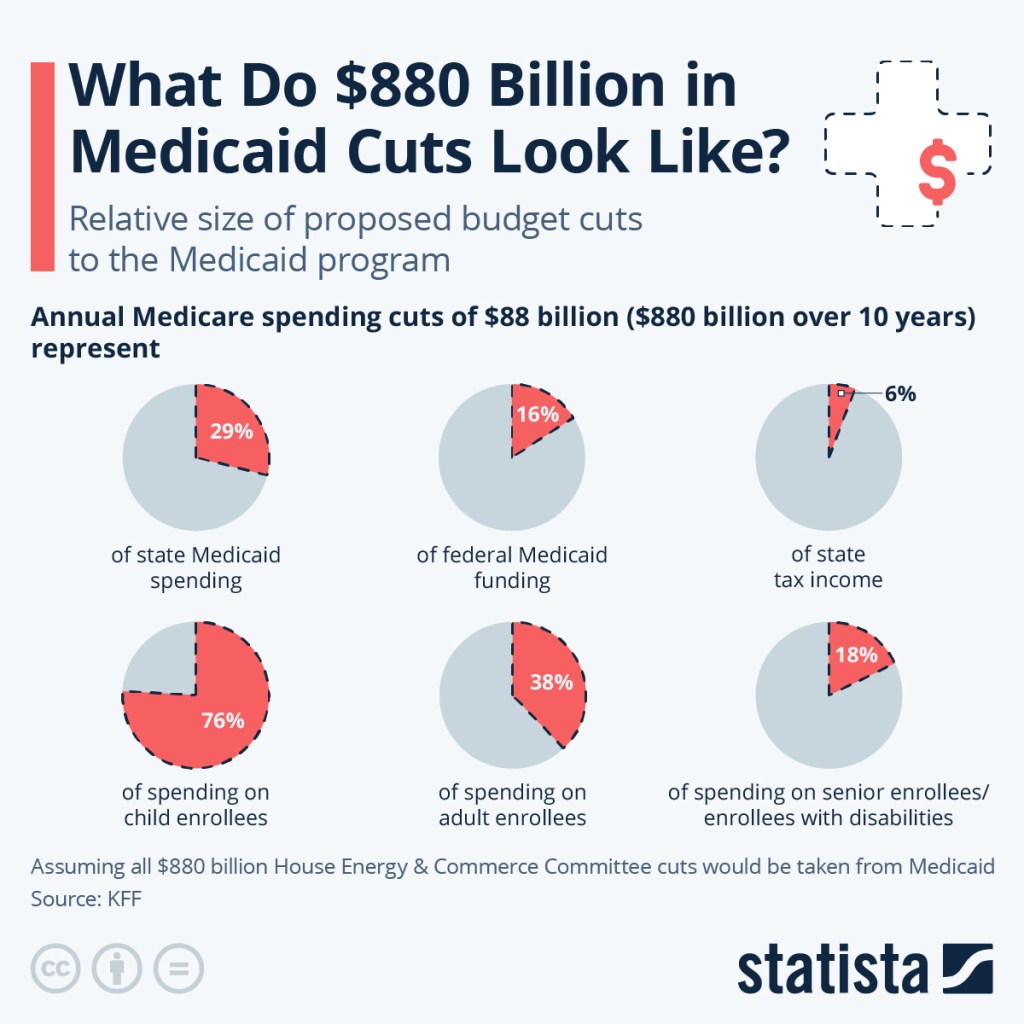
The kind of money necessary to free up the hundreds of billions of dollars required to make the math work is not going to be found in most of the Doge shenanigans. The National Park Service, the Corporation for Public Broacasting, the National Endowment for the Arts, and the like are all a mere pittance. The big money exists in a very few pockets – the Department of Defense, Social Security, Medicare, Medicaid, SNAP. The first target is Medcaid where the goal is to trim 880 billion dollars from the program over the next six years. The total Medicaid budget for 2024 was about $607 billion so the $88 billion a year is about 14.5%. These cuts will remove about 10 million Americans from the Medicare rolls. Of those, about 3/4 will be unable to find replacement health insurance, taking the uninsured population from the current 27 million to about 34 million (or from about 8 to 10% of the population). The details of just how these cuts will be implemented and what programs will be cut are not entirely clear. There are likely to be new work requirements – I’m not sure what industry is going to be hiring nursing home residents or the chronically ill homebound but there does seem to be a shortage of air traffic controllers in Newark. There will likely be new and substantial copays on most services. Most who live in poverty live on very tight budgets and all these will do is make people forego services unless their health is in dire straights. One thing I’ve noticed about congress is that none of them acts as if they’ve ever known an actual impoverished person. I have known many and worked within some of the poorest regions of the country over the years and I know just how devestating even small economic bumps can be.
I’m not saying there’s not fat in the system. There is. Quite a lot actually. The USA spends about 18% of its GDP on health care. No other advanced nation spends more than 11%. We are an extreme outlier and our health system is awash in cash. It’s simply a question of how and what we spend it on. Our current spending trends have gotten us over the last fifty years or so from number one in the rankings of health outcomes internationally to number 37, between Costa Rica and Slovenia.
The current mandarins of no public health experience that have been put in charge in DC have discovered that we are spending an enormous amount of our health care dollars on the management of chronic disease, far more than the rest of the advanced world. They are busy touting vitamin supplements and other panaceas without paying any attention as to what it is about our health care system that is so different from everyone elses. Part of it is the idiotic tying of health care to employment which came about in the 1940s by historical accident and which prevents a singificant portion of the population who cannot be employed (the young, the elderly, the infirm) from accessing health care without laws and federal programs that grant access such as Medicaid and Medicare.
THe biggest difference, however, is embedded in our cultural DNA. We, in the USA, are afraid of aging and death. We regard the perfectly natural processes which lead to our senesence and ultimate demise as being diseases which, by definition, must have cures. We regard death as a failure of the health care system to perform properly. If it all worked perfectly, we’d all go on forever, sort of like Cher (who will turn 79 next week). Our system is mortality based. We expend our resources to prevent death. It’s been estimated that up to 3/4 of an individuals total health care expenses over their lifespans are spent in the last six months of their lives. Preventing death is very expensive and ultimately futile. The mortality rate for society has stubbornly remained at 100% no matter what interventions we have tried.
Most other societies base their health care systems around morbidity, not mortality. They spend their resources on trying to keep their populations healthy. They do not spend lots of money to try to keep a dying person from dying. The societal compact accepts that this is not a wise move and no one asks for or expects prolonged ICU stays for the dying or continuing dialysis in the terminally demented, or one last round of salvage chemotherapy in the semicomatose. To keep their populations healthy they have all hit upon some common themes: an understanding that healthy adults come from healthy young people come from healthy children come from healthy infants come from healthy parents. This is ensured by making healthcare easily accessible, free, and arranging social supports so that children and their parents can be properly nurtured with parental leave, free childcare, access to appropriate nutrition and the like. Healthcare is designed around primary and preventive care rather than around specialty and high tech care. Health systems are controlled by clinicians and public health authrorities with years of training and experience, not by administrators and corporate executives whoss expertise is in the maximization of profit.

MAHA, having discovered chronic illness, has a tried and true playbook for its reduction called the health systems of the rest of the advanced world. Instead of persuing any of this, they’re planning on increasing the uninsured rate by 25%, putting new financial barriers in place between patients and health care access, shutting down long running research programs that have taught us an incredible amount about what chronic disease is and how it works, and discrediting most of the advances of public health of the 19th and 20th centuries. We can return to 18th century public health standards if we so choose. 50-70% of children did not reach their fifth birthdays and those that did make it to adulthood were generally dead before the age of fifty (unless they were in the miniscule aristocratic population that had access to basic sanitation).
I have a lot more to say on all of these subjects. Maybe this is the next book. I’m not going to say it now. It’s late and I feel like curling up with a book and a cat.
 Life, The Universe, and Everything