
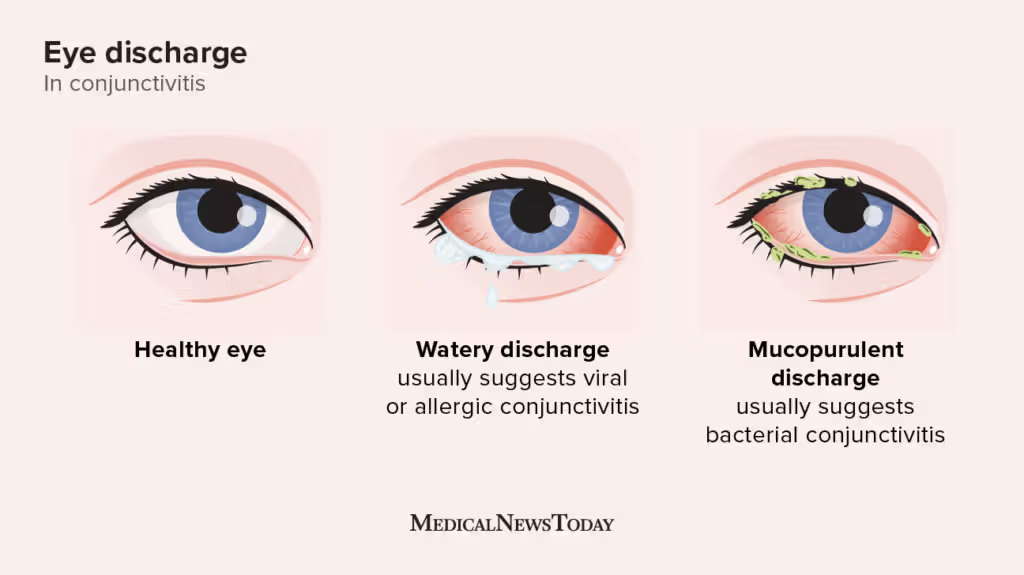
It’s been an unusual week. I last wrote one of these missives last Tuesday evening. Please excuse more typos than usual in that one as I was squinting through one eye. Some hours earlier, in the middle of Tuesday afternoon, my right eye had begun to itch and tear with some filmy discharge for no particular reason. My left eye is my bad eye so, with my glasses off, I couldn’t get a particularly good look at what was going on but it didn’t have any real pain in the eyeball, redness in the sclera or major visual change (the three signs that primary care doctors like me know mean heigh thee to the emergency room) so I posted my remarks, went to sleep, and woke up to even more swelling in my right eye on Wednesday morning. I went in to work, saw a couple of patients, and then my colleagues ganged up on me and demanded that I head off to the Callahan Eye Hospital ER.
Birmingham is fortunate to have a hospital devoted strictly to diseases and injuries of the eye. As eyes are basically exposed brain tissue, it’s not something you want a non-specialist monkeyeing around with Callahan has been around for decades as an autonomous enitty but is not being enfolded into the ever widening embrace of UAB. It was founded by Dr. Alston Callahan who was something of a local legend – and I had the honor of being his physician the last ten or twelve years of his life. He was a good guy. So I figured with some name recognition and my UAB faculty badge I could probably get fast tracked through their ED. I was treated well, but they had no idea ultimately what was wrong. Either viral or allergic conjunctivitis with a great deal more swelling than they usually see. My right eye has now been photographically documented for the eddification of further generations of ophtalmology and optometry students. I always get something weird when I get something. Armed with several different eye drops and some ointment, the swelling has receded, the tearing has ended and I figure I’m pretty much back to normal. I just hope it doesn’t recur.
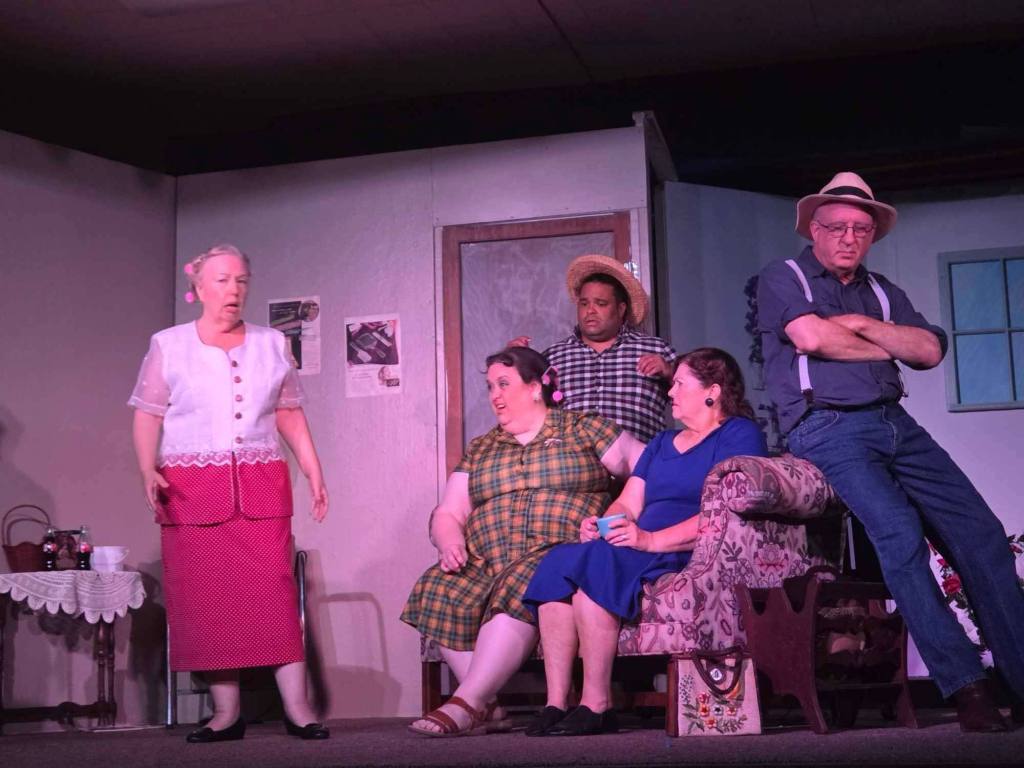
In the midst of all of this, I managed to get through the second weekend of Second Samuel with four more performances met with adulation from audiences. I thought about adding an eye patch to my character but decided that might confuse things a bit and make people think they’d wandered into The Pirates of Penzance by mistake. The show went very well in general. The eleven of us in the cast came together and made a good ensemble. It’s a play that very much depends on ensemble, chemistry, and the creation of a sense of community. You don’t need expensive production values or completely accurate costumes and set dressing to period. The play is about close knit community, what happens when it feels like it has been deceived, and the realization that the bonds of love, friendship, and mutual support are far more important than the little differences between us and that it’s not necessary to know the secrets of others to accept them as whole and good.
I think that the times we are in made the play resonate with audiences far differently than it might at other times. We are all needing to rebuild and reaffirm our communities to hold us close and protect us as the world becomes more and more confusing and unstable. Our society is currently celebrating transactional relationships rather than ones based on mutual understanding and respect and we all need reminders about what’s really important in life and money isn’t the be all and the end all, despite what’s being celebrated in the corridors of power. As another play that’s now some 85 years old and that also addresses the importance of family and community and mutual respect over money and profit – you can’t take it with you.
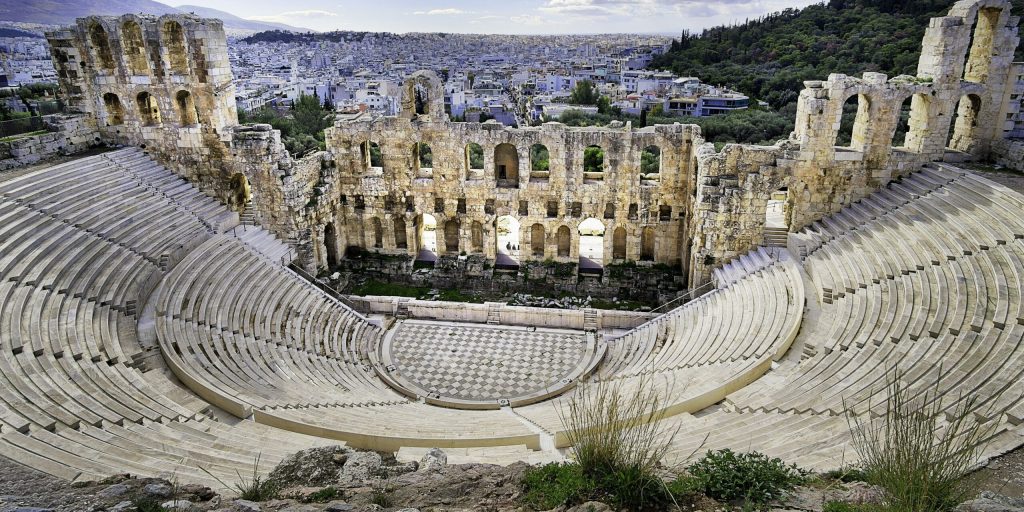
Why do I continue to perform? The obvious answer is that it’s fun to get a certain amount of respect and occasionally a paycheck for playing lets pretend. But that wouldn’t keep me coming back show after show on stage after stage (my current count since beginning to perform seriously in 2003 is about 85 stage productions). I think it’s more about being able to be a storyteller. Since the human species developed language abilities about 150,000 years ago, there’s been a need for stories and for those who tell them. Distant ancestors sat around neolithic campfires and told stories of the past and the ancestors, they anthropomorphized the natural phenomena that affected their lives and created the mythologies which still underly much of our culture. Millennia later, with the development of urban living, stories needed to reach larger audiences and the Greeks created the amphitheater and a chorus to recite the story in unison to provide the volume needed for all to understand. And then, one fateful day, a member of the chorus stepped out of line and took on the persona of a character in the story and the western idea of theatre was born.
It’s an incredible privilege to be a storyteller. To get others to stop what they are doing in their busy lives and gather together to watch and to listen. Whether in a church basement or a sophisticated stage with motorized scenery and hundreds of lighting insturments, magic is created for a time. The story is passed along. The words may be centuries old or written last week. The story may be ripped from the headlines or one that has been told many times in many ways and with which all are familiar. But each time, there is a new spark of understanding that passes among performers and audience. We don’t know what will become of it. Some are quickly extinguished. I’m now performing regularly with young people who saw a show I was in fifteen or twenty years ago and that experience was one of the things that led them to seek out their own adventures. I won’t be able to keep it up forever. My eyes will make wandering around in the dark backstage dangerous. My knees will keep me from doing certain kinds of repetitive movement. My brain will stubbornly refuse to retain and regurgitate my lines in the way they’re supposed to come out. I’ll hold on to this gift as long as I can.
Those currently in charge who are dismissive of the arts want to create a far poorer society for us. The arts help us understand things in new ways so we can problem solve (look up the story of Mendelev and how he came up with the periodic table for a good example). They are a mirror in which we can see ourselves, the noble, the good, and the ugly and begin to fix our problems. They are what nourishes our right brain – which is just as large and complex as our STEM oriented left brain. They can gut federal and state funding for the arts. They can close museums or try to force new rules for interpretation. They can censor or forbid certain types of artistic expression. It won’t work. It’s never worked. As long as their is human imagination, there will be artists and they will be compelled to create. Creation is one of our most basic instincts and not subject to political whims.
It’s going to be tough times financially for awhile. Basic costs for food, housing, and energy are skyrocketing while uncertainty in the political and economic landscape dries up opportunities. If I prioritized money over all else, I’d dial way back on my support for performing arts in this community. I have no idea what my financial future holds any more given how all the rules are changing. But I hold on to the old adage Radix Malorum est Cupiditas and, like Ephraim Levi, I’m going to treat my money like manure – not worth a thing unless it’s spread around encouraging young things to grow.
 Life, The Universe, and Everything