August 24, 2022

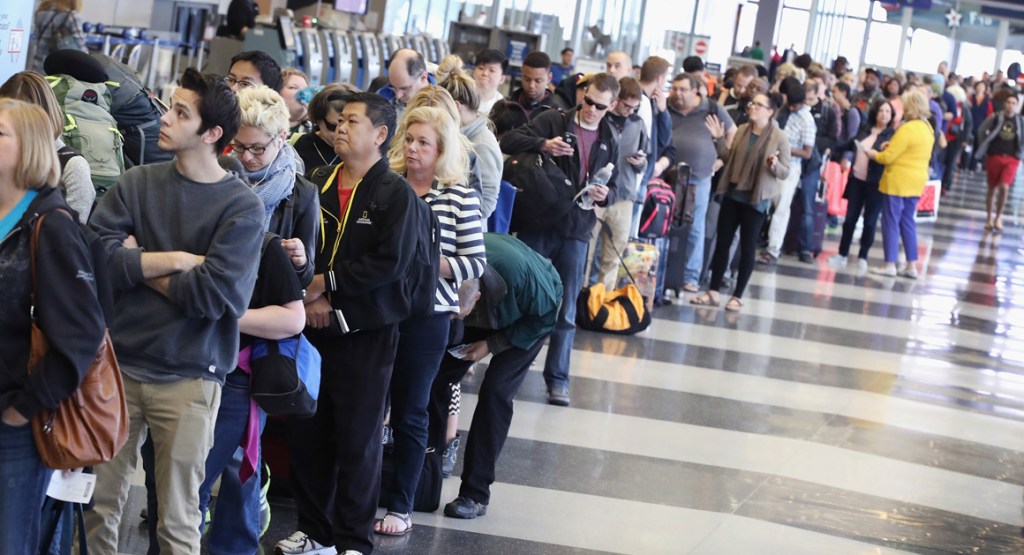
CHICAGO, IL – MAY 16: Passengers at O’Hare International Airport wait in line to be screened at a Transportation Security Administration (TSA) checkpoint on May 16, 2016 in Chicago, Illinois. Waiting times at the checkpoints today have been reported to be as long 2 hours. The long lines have been blamed for flight delays and a large number of passengers missing flights completely. (Photo by Scott Olson/Getty Images)

I am back in the Southeast but haven’t quite made it back to Birmingham. I’m getting older and wiser so when I had a flight from Seattle that didn’t get in until 8 pm, I decided it was best to spend the night in Atlanta and drive back today rather than to brave I-20 after a travel day. I looked forward to sleeping in, but my biological clock is a bit screwed up so I woke up at 5:30 AM local time, but that doesn’t mean I have to get out of bed at an early hour. So here I lie, listening to the muffled sounds of an Atlanta freeway outside the window. I am not getting on the road until after morning rush hour which, knowing traffic in the ATL, should be around 10 am.

Yesterday was a travel day that once again showed the lingering effects of the pandemic on society. I got up relatively early, had breakfast with my father, and headed out the door about 8:15 to catch the light rail to the airport, about a five minute walk. Due to construction, only every other train runs through downtown to Sea-Tac so it was a bit of a wait but I ended up at the airport at 9:30 AM, plenty of time one would think for a 11:30 AM flight on a Tuesday. The departure terminal was a zoo. A lack of Delta baggage and ticket agents meant that the line to drop off bags snaked 100 yards down the concourse. Only two of six stations were manned (and I seem to have been behind a large number of extended families who spoke little English ) so nearly 45 minutes to accomplish that chore. Then into the TSA line, another 45 minutes due to a shortage of TSA agents. I made it to my gate just as my boarding group was called. It’s a good thing there were no transit delays. I was worried about ATL this trip. SEA was the problem.

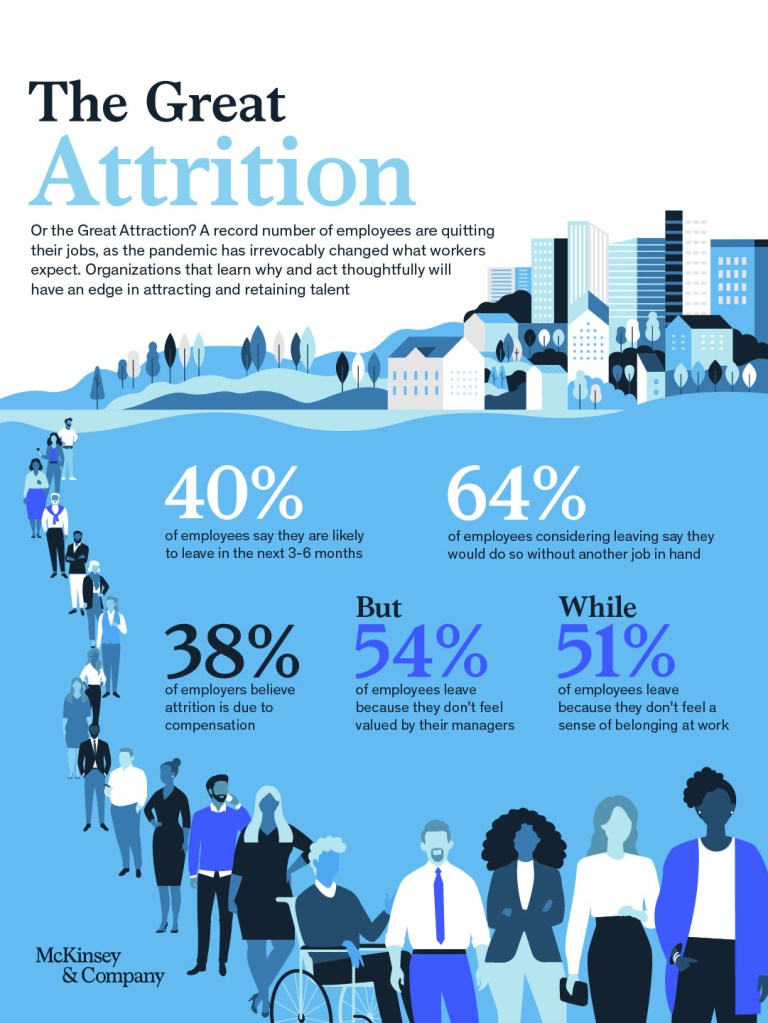
It’s going to be quite some time before all of the issues with services recover from pandemic related effects. And it’s not going to sit well with a population used to instant gratification. I don’t know what all of the causes of the current bottlenecks are but I can guess. Workers who have died or become disabled from Covid and its complications. Workers who are not seriously ill but who are continuing to quarantine as they should when infected. Workers who have had to leave jobs as the caregivers for children or the elderly within their family systems died and they have had to step up into those responsibilities. Corporations that have not adjusted salary scales for new realities making some jobs simply unattractive. Early retirements. Vacancies in better paying jobs and workers moving up leaving the more menial positions open with fewer entry level employees available due to demographics and anti-immigrant sentiment. Workers unwilling to face the public day after day given the decline in civility and increasing abuse they have to face. The same trends are leading to airport lines (inconvenient but bearable) and the inability of me to get services lined up in a timely fashion for my patients (which will lead to people getting sick and dying when they need not).

For some reason, while waiting in yet another queue, I was inexplicably reminded of my grandfather. John Bertrand de Cusance Morant Saunders was a man of short temper who had no time for the inconveniences of the world. When faced with something like a delay in travel, he would bluster and look around for someone to blame and then let them have it if he could identify a convenient target. He was usually polite but between his imposing physical size, his British colonial accent, and his force of personality, he usually got what he wanted. He mellowed a bit late in life, especially after driving his car into a ravine at the age of 83 in what, given my personal experiences with him behind the wheel, was likely a fit of road rage. He was not seriously injured and he continued on for another five years after that particular incident. When he finally did pass on of natural causes at the age of 88, he left instructions that he be cremated and his ashes interred with my grandmother.

Melrose Abbey

There was a slight problem with this. No one in the family was quite sure where my grandmother was. She was a Scot from Dumfries who grew up and spent most of her young life in Edinburgh, which is where she had met my grandfather (he was in medical school, she a practicing physician). When she died, my grandfather made arrangements for her cremains to be returned to Scotland and buried there. He would not let the rest of the family in on the details but let us know that he had her buried in a cemetery in Melrose. Melrose is a lovely little town, site of the ruins of Melrose Abbey (mainly destroyed in the 16th century wars between England and Scotland). Why he would put her there, we do not know as there were no family connections to the town. Her family were buried in Dumfries, on the opposite side of the country.

She died and was interred in 1976. In 1983, my cousin Jenny, while on her semester abroad made her wat to Melrose and combed the cemeteries looking for our grandmother’s grave. No luck. I followed on my European jaunt in 1984. I too checked every cemetery in town and inquired at the town hall. Still no luck. My parents and my aunt and uncle, on various trips to the British Isles in the late 80s also had no luck. My grandfather was approached but didn’t want to talk about it (he had since remarried). He died in December of 1991 and Steve and I headed up to Seattle for the Christmas holidays that year. While we were there at my parents house, UPS rang the bell and handed me the box with my grandfather’s ashes in it. All I could think of was to call over my shoulder to Steve ‘Grandad’s home’. He wasn’t amused.

Grandad’s box lived in my mother’s shoe closet for the next year or so while my mother and aunt tried to figure out just what had happened to my grandmother so that he could be sent to join her. This involved a number of letters to local authorities inquiring where human cremains sent internationally some sixteen years before might have ended up. We did find out that she had indeed been buried in a cemetery in Melrose. The reason none of the family expeditions had been able to find it was that my grandfather had neglected to purchase and install the headstone as he had claimed. My grandfather was eventually sent over and laid to rest with my grandmother. My mother and aunt had the last laugh though. In Scottish tradition, a woman, when she marries, does not lose her own identity to her husband and family so the marker that was erected reads ‘Sacred to the memory of Alison Jean Maxwell-Wood MD and to her husband John Bertrand de Cusance Morant Saunders MD’. I haven’t been back to Scotland since it was erected but I will eventually go and pay homage. They, for better or worse, are part of what made me who I am.

August 20, 2022

I was a voracious reader as a child. I pretty much taught myself to read between 3 and 4 and was pretty solid by the time I entered kindergarten, having graduated from picture books to chapter books. I started in on adult literature around age 10 and anything that was left lying around I was likely to pick up and try. I don’t think my mother was amused when she found me reading Kurt Vonnegut’s Breakfast of Champions at that age or Mario Puzo’s the Godfather a year later. My mother was, however, relatively shrewd so she figured out that if I was going to read adult material at a young age she was going to guide me and soon she was handing me paperback editions of various classic novels and modern literature for me to read and discuss. By fifth or sixth grade I had worked my way through Jane Eyre, Wuthering Heights, The Count of Monte Cristo, The Three Musketeers, A Tale of Two Cities, Brave New World, 1984, and Auntie Mame among dozens of others.

One of her selections for me was Richard Llewellyn’s story of a Welsh coal mining community, How Green Was My Valley. I don’t think anyone reads it much anymore but the film version with a child Roddy McDowall in the central role is still played on Turner Classic Movies as it was a Best Picture winner back in the early 40s (now chiefly known as the movie that beat Citizen Kane). I read the novel several times as the child protagonist of roughly my own age, the themes of the tight knit family and community being ripped apart by forces beyond their control, and the degradation of the landscape by the byproducts of industry all spoke to my still developing mind. I hadn’t thought about the book for years but today, while wandering the streets of Seattle, it came back to me in full force.

The city of Seattle I grew up in peeks through here and there but the city that is now is unfamiliar. Landmarks have been bulldozed, the rapid increase in population has led to more and more single family homes being replaced by multiunit dwellings, usually cheaply manufactured and ill maintained, the parks and green spaces have been allowed to deteriorate. The city just feels dirty in ways that it didn’t in the past. There’s less care of private dwellings and yards. There’s graffiti everywhere. The streets are full of pot holes. There’s probably very good socioeconomic reasons and stresses behind this that I’m not fully briefed on, not having lived here for thirty five years. But as I was musing on this, I had a sudden recollection of the last line of that novel I read nearly fifty years ago: “How green was my valley; the valley of them that are gone.” It’s a brief sentence that combines the ideas of you can’t go home again with wariness of childhood nostalgia. So I guess that’s where I’m at. Feeling on one level that I am home and this is where I belong and on another level that it’s moved on without me and that Birmingham is where I need to be.

Not much has happened in the few days that I have been here. The weather has returned from Alabama heat and humidity to Pacific Northwest room temperature and breezy. I attended a birthday party at one of the parks on Lake Washington this afternoon and looked out over the blue waters thinking of my endless childhood summers at the Laurelhurst Beach Club where we all spent our time digging in the sand, swimming in the lake and flinging ourselves off various diving platforms. The crows in the trees were eyeing the picnic goodies and the ducks from the lake were intent on my Cheetos. (I gave in and fed them a few. I know you’re not supposed to but I’m a sucker for a soulful glance from any sort of animal). I did not swim.

The Laurelhurst Beach Club

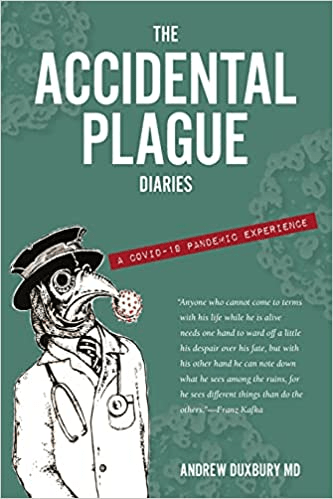
My talk to the residents of my father’s senior living facility was a success. I’ve figured out just the right balance of stand up, story telling, medical information, and common sense to hold a senior audience for ninety minutes. I just hope they all buy a copy of the new book when it comes out. I did meet my editor/publisher briefly and we should be on track to have it finished and available by the end of September. At that point, I will take a little break and start thinking about Volume III of these Accidental Plague Diaries around New Years. I am hoping that will be volume the last. If enough people will get their boosters and the virus doesn’t have a a particularly nasty mutation in the next few months, we may be at the end of the pandemic and firmly into endemic territory by the end of the year. We shall see.

Tomorrow, we have a gathering of the clan at my brother’s house so we can all catch up with each other for a few hours. Then I have one more day of unstructured time before returning back to the Southeast on Tuesday. I haven’t decided what I’m going to do with Monday yet. Something will present itself, it usually does. In the meantime, to bed. I have more sleep to catch up on.

August 18, 2022

Time to shift focus away from Covidland and back towards itinerant wanderings for a few days. I haven’t wandered far off my usual beaten path, just off to Seattle for a few days to see the family. I try to get up here about twice a year but pandemic fallout of various stripes has made that a bit more difficult over the last couple of years. Anyway, I am ensconced at my father’s senior living facility, after having partaken of the special Roaring 20s dinner they were having this evening to celebrate the 13th anniversary of its opening. My parents moved in during its first year so my father is among the original cadre of residents that remain. The dinner was good as was the Manhattan cocktail that accompanied it. My father, at nearly 90, had two and was a bit wobblier than usual but obeyed my strict instructions of not to fall over.

This was my first cross country flight in eight months, the last one happening just as the omicron wave was beginning to envelop the world. Flying has changed a bit. The FAA no longer requires masking on planes or in airports. In Atlanta, there were very few masks in evidence other than on employees where they seemed mainly to be decorative chin straps. In Seattle, there were more – roughly 5% as compared to the 0.5% in Atlanta and far more were worn correctly. If I return from this trip with a Covid infection, I’m going to blame ATL although there’s really no way to know.

The trip went smoothly in general, unlike my last major flight with it’s nine hour delay. Round trip from Birmingham to Seattle was roughly $1,000 more than round trip from Atlanta to Seattle so I decided to fly out of Atlanta, driving over last night after work and spending the night in an airport area hotel. The drive was uneventful until I hit Atlanta around 10 PM, just in time for a monsoon which led to minimal visibility on the interstate and an interesting time had by all trying to negotiate all of the lane changes between I-20 and I-85 in downtown Atlanta. I survived, went to bed, slept in, and then made the short hop to the airport this morning. I allowed an extra hour or so due to all of the travel horror stories of the summer but things seem to have quieted down as ATL was calm and it didn’t take any longer than normal to check bags and clear security. The plane was on time, the entertainment system worked, and (per usual) I slept about half the way. On the Seattle end, no delay at baggage claim, and a brisk walk to the light rail which stops three blocks away from my father’s building.

Tomorrow I sing for my supper by giving a talk to the residents on geriatric issues. As I’ve been showing up regularly for over a decade, I long ago exhausted most of my usual community focused lectures so these days I just put out a call for questions the week before I arrive and make it an ‘Ask Me Anything’. The usual things that come up are specific questions on medications, medical marijuana and the octogenarian, how to stave off dementia, issues with the functioning of the health system and the like. I do my best but occasionally I get thrown a curve ball like ‘Why can’t I live to 125?’ I like giving talks to general older audiences. They’re one of the few groups that actually listens to what I have to say as they’re actually living with the real issues of aging, be they medical or social. My least favorite group to speak to is physicians. In general, they tend to think that because they are physicians, they are already omniscient and as geriatrics doesn’t deal with fancy new drugs or equipment or miracle cures, it’s not worth paying much attention to.

https://vimeo.com/40516254

I’ve learned from thirty five years of public speaking on professional topics how to read the room. Whether my audience is with me, or checked out. When to go off on tangents. When to insert a joke. When it’s safe to insert a macro on a topic so that I just go through it by rote and don’t have to think much. I suppose it’s a skill. I tend to get pretty high marks on evaluations when I teach (except by physicians) so I must do something right. I figure even if I formally retire, I’ll probably keep that piece up. I’m hoping to develop some new talks out of The Accidental Plague Diaries at some point. And there’s still the idea of it becoming some sort of performance monologue piece of some type but that’s going to take a very skilled director to take that material and shape it in such a way that it plays theatrically. If that ever comes to fruition and is published and someone besides myself plays it on stage, I suppose I’ll get to sit in an audience some day and watch someone I do not know interpret my life. That will be an odd feeling.

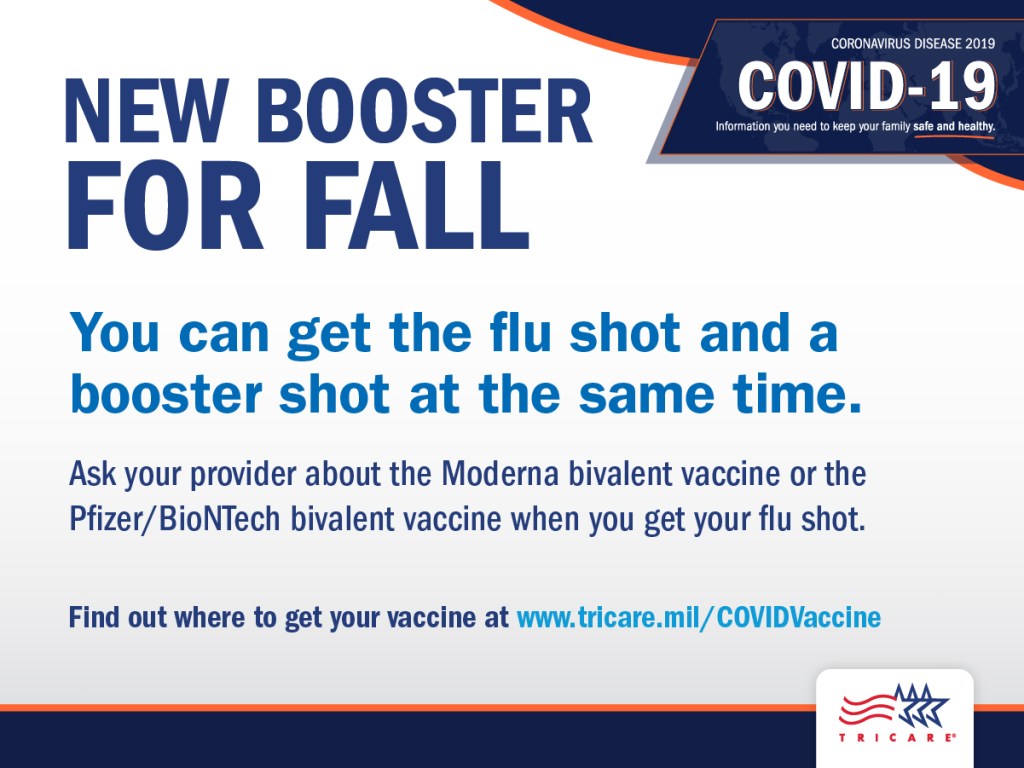
The only thing of note on the Covid front was Monday’s announcement by the FDA that they were going to approve an omicron variant specific variant this fall and that Moderna’s SpikeVax would be getting a nod shortly (it has been approved in the UK). People are asking me, if they have not yet had a second booster, if they should get one or wait. As one can get a booster thirty days after a previous one and as there is no calendar yet as to when the new omicron booster will actually roll out, I’m suggesting that people go ahead and get a booster now and then also get the omicron booster when it becomes available in a couple of months. I got my second booster in late June and will get my omicron as soon as it becomes available. Likely October but anything is possible.

I seem to have brought the weather with me as Seattle is in the mid 80s today and humid (yuck). At least my dad’s building has air conditioning which is usually in short supply around here. It’s supposed to cool down over the weekend. I look forward to that. I am still on Central Time so it is now past my bedtime so I am now going to sign off. My Manhattan is draining my energy…

August 14, 2022

I’m confused. And, if I’m confused, I imagine many of you are as well. Once again, the national public health system is changing its guidelines but without offering clear and concise reasoning behind these changes so that we all can make the wisest choices for ourselves and our families. This has been one of my biggest beefs throughout the whole Covid pandemic – poor messaging. Under the prior administration, it was deliberate for political purposes. Under the current administration, it appears to be due to a lack of marketing acumen which can allow for the necessary information to be reduced to easily digestible concepts and then given to all of the various media outlets in a consistent fashion. I am no fan of Fox News, but the federal government could learn a thing or two from them. They’re masterful at this sort of work.

Anyway, I have done a little poking around into the new CDC guidelines and some reading on what else seems to be happening these days in Covidland so I’ll do my best to clarify what all this means as I see it. First off, our late summer BA5 omicron surge appears to be waning somewhat. The number of new cases reporting daily has been slowly dropping and, at current trends, should be back under 100,000 a day by Labor Day. The number of people in the hospital and the ICU also are slowly descending (roughly 50,000 and 5.000 respectively at the moment). The only indicator that has been creeping up is the death toll which is nearing 500 a day, well over double what it was a couple of months ago. This is probably the usual lagging indictor phenomenon where the death rate rises 4-6 weeks after the case numbers start to go up. Will these numbers go back to the lows of late spring? Will numbers really start to peak in the fall? Who knows. Tune in tomorrow…

When one looks at the CDC guidelines, it’s clear that their ultimate goal regarding the pandemic at this stage is not to prevent all disease and transmission but rather to prevent serious disease that requires hospitalization. The agency is smart enough to recognize that mild disease from which one can recover at home is likely to simply be an endemic part of our lives going forward. They understand that the acute care health system, as battered as it has been over the last few years, is in difficulties and that the most important thing for society is to preserve its functioning so that it can take care of all of the other non-Covid related needs we have, especially in light of the rapid aging of the population due to the demographic position of the Baby Boom. I think we just need to keep that lens firmly in place while scrutinizing what the agency has to say. The major problem with this approach is that it does not take into account different risk stratifications for different populations; when that happens, higher risk subgroups are more likely to bear the brunt of disease morbidity and mortality.

The current CDC guidance on quarantine/isolation is to remove the requirement that someone who was exposed, but not sick, should isolate for five days in order to break transmission chains. No one was really doing this anyway, at least not in recent months, and I suppose that they feel the risks to society from excess quarantines and short staffing were worse than the risk of potential transmission. They still request quarantine for five days from initial symptoms/testing positive with an additional five days of total masking. This is all well and good, but there is some evidence that BA5 remains infectious on day 5. The CDC making this recommendation means, of course, that employers can require workers to come back to work after five days, even if they might transmit to coworkers. It will be interesting to see if there is a spike in workplace transmission as compared to general community transmission. There are also social justice concerns as lower paid workers are more likely to have jobs needing in person contact while higher paid workers may have work from home options. There is no requirement under CDC guidelines that there be a negative test to ‘clear’ someone. PCR tests in particular can read positive for days after the ability to transmit has been lost. I don’t know if this is a good or a not so good thing.

The CDC continues to publish weekly data by county on whether transmission locally is low (masks not needed), medium (masks should be worn indoors by those most at risk) or high (everyone should mask indoors in public). These numbers are not generated based on the risk to an individual being exposed but rather on what transmission rates are likely to do to the local health system in terms of generating serious cases which will require hospital or other acute care. Therefore, they are affected by such things as vaccination rates in the population, statistical analysis on the amount of native immunity present from previous waves, numbers of hospital and ICU beds available etc. Jefferson County Alabama, is currently in the ‘high’ level. I don’t think the local population is reading the CDC website however as I don’t think I’ve seen a lot of masks recently at the grocery store. We’re still masking at work and at church so I’m not worried. King County Washington, where I’m travelling shortly, is in the low category. There’s no CDC readings for Delta Airlines jumbo jets travelling between the two.

The most American piece of the new CDC guidelines is basically that guidance should be tailored to the individual and the individual’s understanding of risk. That’s all and good, but as a public health strategy, it will open up a lot of subgroups to higher risks of infection or reinfection and that in turn is going to mean continued cases, continued rise in long Covid cases with completely unknown sequelae in the future, and the potential of putting the elderly and those with compromised immune systems in harms way. Fortunately, we do have a decent weapon in the arsenal with the oral antiviral Paxlovid which seems to be quite effective against omicron and helps prevent cases from advancing to the point that hospital care is needed. It’s now widely available and it may be why the current wave hasn’t been worse.

What does this all boil down to? First, get your vaccines and boosters. Fully vaccinated at this point means at least one booster and, if you’re over fifty or have a chronic illness, I’d go get that second one and not wait. Yest, there’s supposed to be an omicron specific one in the fall but who knows when that will actually be in widespread distribution. I’m planning on taking each and every booster that comes down the pike as those unknown long Covid issues (and long Covid seems to strike 15-20% of those with an infection and the more infections you have, the more likely you’re going to get it) are not something I want to learn about first hand. Second, if you do get sick, get tested and, if positive and symptoms are anything above minor cold symptoms, get a prescription for Paxlovid. If you’re without insurance and can’t afford that trip to urgent care, head straight for the pharmacy. Under the current FDA rules, pharmacists can prescribe and dispense without physician authorization. Third, when indoors with others I’d read the room and put your mask on if you think there’s a chance someone there could expose you. Fourth, you know the litany – wash your hands, use common sense, stay home if you’re sick with anything.

August 10, 2022

Sad adult woman sitting on dark home corridor floor.

I went to a birthday party this past weekend. It was low key, mainly people of my generation (mid 50s to mid 60s) and a mix of folk who had known each other for decades and newer acquaintances. Once the usual topics of conversation such as entertainment and politics had been exhausted and we moved into the more personal, nearly everyone had the same story to tell. They were exhausted. Some were taking FMLA or other time off from work. Some were devising retirement plans. Some were trying to figure out how they were going to be able to keep up their usual professional pace without dropping in harness. This was an upper middle class professional bunch, working in health care, education, ministry, the not for profit world. And every single one was feeling the same.

I fit right in there with them. I’m running out of gas. I’m not quite to the coasting on fumes stage but it probably wouldn’t take too many further reversals to push me there. I’ve been thinking a whole lot about what’s causing this. I think just blaming the pandemic or the viciousness of our current political moment is too facile an answer. I think it’s something a bit deeper and a bit more primal. I think we’re dealing with an enormous amount of unrealized and sublimated societal grief. And if there’s one thing that I’ve learned from the last nearly forty years of my life in medicine and as a double widow, grief will always out. It may be transformed into other emotional states through circumstance or force of will but it will continue to rocket around your brain and your life until you acknowledge it and identify it and deal with it and grow around it until, while it remains a part of you, it is no longer the defining part.

What is grief? The dictionary defines it as ‘deep sorrow, especially that caused by someone’s death’. But, again, I think that’s a bit too simplistic because grief can happen in many circumstances that don’t involve death. One of my most acute episodes involved my finishing up thirteen years of higher education. I’d made it! I didn’t have to go to school or training any more! I was, to my knowledge, the first person in my medical school class to receive a faculty appointment at a major university. I had to grieve the loss of a linear way of living from educational milestone to educational milestone, neatly laid out like a treadmill and adapt to a life where there was no longer a road map. It took me about a year and a half to do that.

I think grief is what happens when the reality of our current circumstances differs from our imaginings and planning and expectations of what those circumstances should be. Death, of course, changes everything, especially the death of a spouse or other close companion. The mind can’t really conceive of the future without that other important person being a piece of what’s to come and if they are irrevocably removed, there’s a huge cognitive dissonance. But the same thing happens with more minor traumas and disappointments: the need to cancel a planned vacation, the inability to attend a social event or milestone celebration such as a wedding or graduation for someone important to our lives, the expectation that American society will rise to a challenge and act for good and instead, in many ways, does the opposite.

Two and a half years of pandemic has ripped well over a million Americans out of the social fabric from Covid through death. Each one of those missing people has left a social circle bereft with traditional mourning grief. Some people have only lost an acquaintance. Others have lost multiple family members. Hundreds of thousands of children have lost a custodial parent. Hundreds of thousands of aging parents have buried a child. But what of those who became seriously ill but did not die? I take care of a few of them. I have people with long Covid whose bodies were so ravaged that they will never resume normal activity again. They’re alive but grieving the trips they’ll never be able to take, the hobbies they’ll never be able to pursue, and their spouses and families are grieving the huge alterations in their own lives due to their loved one’s care needs. (I’ve been there – having a seriously ill person at home is no fun). Then there’s those who have recovered from acute Covid but who now have long Covid symptoms which are poorly understood and which no one really knows how to treat. They too grieve the loss of their past health and function and face an unknown future.

Then there’s the years of cancelled and postponed societal rituals. For me, this included the inability for my family to have a proper memorial after the death of my mother, the cancelled theatrical opportunities, the inability to make music as a choir, the lack of group dinners out, cast parties, or drinks with colleagues after a particularly stressful work day. Many of these things have started to return in a somewhat modified form but all of those missing events and interactions has each left a lingering trace on the grief pile and that must be felt and addressed. And those missing threads in life’s tapestry are causing all of us to become more detached from each other and part of the reason why so many of our social institutions – health care, education, cultural opportunities – seem so shaky.

Perhaps the biggest contributor is how the pandemic has laid bare the deep political and social divisions we have. I don’t care which side of the fence you’re on, every one of us is looking at the American political landscape, riven by distrust, if not downright hatred of the opposition, egged on by a media ecosystem that cares only about clicks and revenues which are best fed by maximum conflict, and wondering where is that ability we have always known in the past for Americans to all pull together for the common good in a crisis and will we ever have that again? That’s a huge loss of faith and certainty in how the world should be and when that’s added on top of the deaths and the disappointments, it’s a recipe for disaster.

I’ve learned about how to cope and lessen grief over time – and there’s really only two things that work: time and other people involved in your life. Antidepressants and other quick fix pharmaceuticals usually don’t help much. You have to develop the coping mechanisms and put in the time. What are mine? Well you’re reading one of them. These essays and the books that have come from them are perhaps my most obvious constructive response to my personal grief. I find that the actual patient care piece of my job and the time I spend face to face with patients where I can use my skills and my empathy and my ability to simply listen gives me renewal. The piece of my job that interfaces with administration and the system…. well that’s another story. I think this works because so many of my patients are now in their late 80s and 90s. They have living memories of a worse time: the Depression and World War II. They survived. They developed resilience and coping skills. Look up the elders in your life and listen to them. They can teach you a lot about how to deal with today.

I know I’m being a bit of a negative Nellie with this particular post, but I’ve learned through these writings that when a thought like this is rattling round my brain, best to get it out. I’ll sleep better and have a bit more energy tomorrow. Unlike today when I fell asleep on the couch in my voice teacher’s living room waiting for my lesson, despite the very loud scales from the lyric baritone coming through the wall. As I told my voice teacher, I was an intern. I can sleep through anything.

August 6, 2022

We haven’t run the numbers for a bit. Where are we? About 100-120,000 new cases of Covid being reported daily in the US. This is about four times the low spot of late spring when we were down to about 30,000 cases daily and about a tenth of the peak of omicron this past January when we were at nearly a million new cases a day. Is the current number accurate? Probably not as health departments are not as timely or as exacting with their data reporting and because the majority of home test diagnosed cases aren’t reported and counted correctly due to all the barriers that stand in the way of that data collection. Deaths are going up again. We’re up from about 300-400 deaths a day a month ago to about 650 deaths a day nationwide. That’s nowhere near what we had earlier in the pandemic but it’s still a significant increase over the last few weeks, likely reflective of the increase in cases as omicron BA 5 continues to spread with its pesky habit of getting around our various immunities, both natural and vaccine derived.

Assuming that we stay even at roughly 650 deaths daily, that’s nearly 20,000 deaths a month or about 235,000 deaths a year. That’s enough to enshrine Covid as the third leading cause of death in the US for some time to come, bested only by cancer and heart disease (both about 600,000 a year) and roughly ten times the usual flu death rate which usually hovers somewhere between 20,000 and 30,000 annually. So, if Covid is here to stay in an endemic fashion, it’s still a problem not to be taken lightly and my best advice to everyone is to keep getting those boosters as they come down the pike, just like you keep getting flu shots. I’m not convinced that we’re at the end of the road yet. I still think we’ve got a nasty little surprise or two coming.

Has the availability of Paxlovid, the antiviral drug combination which if taken early in the infection, made a major difference in the mortality and morbidity statistics? I honestly don’t know. It certainly hasn’t hurt. There’s a bit of misinformation about Paxlovid floating around out there. First off, it’s not a prophylactic. If you go to a wedding and you find out later that the person across the table from you had Covid and decided to come any way, taking the drug won’t protect you from infection. It’s only for those who are actually actively infected. If you are infected and you’re young and healthy and your symptoms are mild like a bad cold, should you take it? It won’t hurt but it’s probably not necessary. It’s probably best used by those who are starting to get slightly more symptomatic such as fever or worsening cough, especially if they are at risk for severe complications from age or from other underlying health issues or immune deficiencies. For it to be helpful, it has to be taken within four or five days of the start of symptoms and it’s a five day course. It’s standard dosing unless you have kidney function issues requiring a lower dose. It doesn’t have a lot of side effects. There is some talk about Paxlovid rebound – a worsening of symptoms following finishing a course for a few days, but it’s unclear if this is a real issue or not. Will I take it if I get infected again? Won’t hurt, might help, can’t think of a major reason not to.

The problem with Paxlovid, indeed with all medications within American health care, is that the general population thinks of them as magic. Feel bad? Take a pill and presto changeo the miracle happens and you’re back to normal. The problem is that health, disease and pharmacology are a lot more complex than that. (That’s why pharmacy school is a four year program after college). Drugs are controlled doses of poisons – substances designed to alter your physiology in one way or another. They don’t do the same thing in all people. One of the dirty little secrets of pharmacy is that pretty much all drugs don’t work in between 5-25% of people because of genetic variations in physiology. They don’t do the same things in the same person at different times in the life span due to alterations in body composition over time. They can interact with each other in highly complex ways that no one understands. There has never been a controlled trial of a human being with more than three medications circulating in their system at once. It’s too complicated to study using those sorts of rigorous scientific methods so when someone takes ten, fifteen, twenty-two different medications daily, we haven’t a clue what’s actually going on. We’re just making our best guesses.

I’m going to reduce four years of pharmacy school down to a couple of paragraphs to help explain some of these concepts. There are two basic things to consider. Pharmacokinetics and pharmacodynamics. Pharmacokinetics are the movement of drugs through the body and pharmacodynamics are the body’s biologic response to the drugs once they reach their destination. Pharmacokinetics are affected by four basic processes. The first is absorption. Most drugs are administered as pills and enter the stomach and pass into the intestine for digestion. The chemicals are then taken up across the intestinal lining and enter the blood stream. As the gut is one of the earliest body systems on an evolutionary scale, it works pretty well most of our lives and absorption doesn’t change a lot with age. There are some exceptions. First, some pills come with capsules and coatings that require stomach acid to properly disintegrate and a lot of older people, due to changes in the stomach and reflux, take a lot of antacids which may keep this from happening properly. Second, there are some specific categories of medicines not taken up as well as the transport systems in the gut deteriorate with age – these include positively charged ions such as iron and magnesium and vitamin B12.

Our second pharmacokinetic system is known as distribution. Drugs, like other chemicals, either prefer to dissolve in water or in fat/oil (hydrophilic or lipophilic). The body has both of these available. Water in the circulation and lead muscle tissue and we all know about fat. As we get older the proportion of fat to water tends to increase meaning that hydrophilic drugs have less volume to dissolve in and so their circulating concentrations go up and the lipophilic drugs have more volume meaning they are going to stick around longer in the body and clear less effectively leading to much longer half lives. I always had a problem understanding this when I took second year pharmacology in med school so if you have no idea what I’m talking about, you’re not alone.

Lastly, we have metabolism, the changing of drugs from one form to another, usually by the liver, in preparation for either use by the body or to become an inert form or a form which can be cleared from the body – something that slows with age and, of course, excretion, where the drug leaves the body either from being moved from the blood stream into the urine through kidney function (declining with age) or by the lower part of the GI tract. Paxlovid is subject to all of these processes as much as any other drug. It is eliminated in the urine so in those with renal dysfunction, it doesn’t cross through the kidneys quickly enough leading to toxic buildup which is why it must be administered in lower doses. It also interferes in the metabolism of several other common drugs and those drugs often need to be held while taking Paxlovid. Your pharmacist can advise you.

As one gets older or develops health conditions where you’re on routine medications, one of the best things you can do for yourself is choose a single pharmacy to fill your prescriptions and make friends with your pharmacist. Their scope of practice is quite broad and they are the experts at catching interactions between medications and other medications related problems, but to really do it, they have to know you and your whole med list. When you’re filling things at three different pharmacies, no one is able to see the whole picture and catch things early. With the number of patients I see, the complexity of their medical problems, and the numbers of medications they take, I rely whole heartedly on the pharmacists I work with to help keep me on the straight and narrow, or to at least keep me from killing too many of them.

And there you have it. I’ve just saved you $80,000 in pharmacy school tuition. Hopefully you’ll use some of that cost savings to take care of yourselves and buy a little gas for the car so you can go get your boosters as they become available.

August 2, 2022

Steve having a bath with Patrick Flanagan

Binx, the new cat, emerged from wherever he’s found to hide in this condo to stare at me for about three minutes, and then he turned tail and ran back to his safe space. I’m not exactly sure where that is. When I discover one, he appears to abandon it for somewhere else so he hasn’t been back in the fireplace, behind the bins of of cleaning supplies in the hall closet, or squeezed between the washing machine and the wall. The condo isn’t that big and there’s only so many possible places so I suppose that as I discover each one in turn, lowering his number of undiscovered hidey holes, he may eventually decide I’m not that bad and actually come out and join the fun. As long as there’s evidence that he’s eating, drinking, and using the litter box, I’ll let him make up his own cat mind in his own cat time. Oliver, the other cat, who is now about sixteen, appears to be ignoring him so I don’t expect any real issues.

I’ve had cats most of my adult life. I would, in may ways, rather have a dog or two but the odd hours I keep and my tendency to disappear from home for a couple of days at a time when working on both work and theater projects just precludes giving a dog the time and attention it really needs. Maybe after I retire. Steve and I started with cats back in 1993 when we moved from our 1200 sq foot condo to our 2700 sq foot house. Patrick Flanagan was the first. He was an orange tabby rescued by a friend from a feral litter under a nearby house. In Steve’s researches into the history of our condo (the top floor of a late Victorian house in midtown Sacramento) and our newly purchased house (an Arts and Crafts bungalow several blocks away), he discovered that both buildings had been owned, at one point by a Mr. Patrick Flanagan and so the cat was named in his honor, and because his ginger fur meant he was probably Irish. We then discovered that the modern day Flanagans of several generations later were living across the street and we became good friends. Patrick was joined by a second cat, Big Al (named after Allan Owen) for a while but he did not last long due to his unfortunate habit of spraying everywhere.

Binx in Hiding

When we moved from California to Alabama, Patrick came with us. He did not appreciate the four days in the car that it took for us to drive cross country. He would lay splayed out on the floor of the car not moving and then, when we got to the motel, would crawl up under the blankets and hide for an hour before coming out to use the litter box and eat and drink. He eventually got used to the Aerie and was Steve’s constant companion during his long illness and helped keep me sane after his death. When Tommy arrived, a few years later, he brought his two cats with him, Shadow, a gorgeous Himalayan with Siamese seal point markings and Willie, a small grey tabby. Willie developed diabetes and one or the other of us was always having to race home to give him an insulin shot during the first year of our living together. He eventually died of complications of the disease.

A few years later, we got Archie, who was sort of a buff color with pointed Abyssinian ears. He was a trouble maker. That brought us up to three which we thought was a good number. Then Patrick died after a long life and we went looking for a third. At the adoption room, we found a pair of litter mates, long haired and gorgeous who we decided to take as a set, Oliver, a dark gray and Anastasia, an off white. We became a four cat household. Anastasia was very much the princess, serene and aloof while Oliver hated everyone and only turned up for meals asking for more. Over the next fifteen years, Shadow, Archie, and Anastasia all left for cat heaven after long lives leaving me only with Oliver (who changed his behavior to become a loving little fur ball after he became last cat standing) and now Binx. Oliver is about sixteen. Binx is less than a year so I assume I’ll be down to a single cat again in a couple of years unless someone else gifts me one. I have two requirements: fixed and litter box trained.

Anastasia being a princess

So what does this litany of cats have to do with viral pandemics? A lot. Our pets help sustain us during our dark times. They help us meet our need to be needed when we’re separated from others. They offer unconditional love and acceptance. Their antics amuse us. The provide some unpredictability. In this last few years of pandemic, especially those of us who live alone, have needed the feeling of companionship that a dog or a cat can provide. This is leading to a bit of a problem now that the world is becoming more open. People acquired dogs and cats out of immediate emotional need a couple of years ago and they don’t have those same needs now. The responsibilities of pet ownership, however, are still there – and the expenses. Food, vet bills, boarding and all the rest. There’s been a significant uptick in dogs and cats abandoned or surrendered to shelters. The current inflationary spiral putting a strain on household budgets hasn’t helped. You can get rid of a pet for cost savings much more easily than a child.

I can’t help but wonder, as certain forces in our society seem to be determined to undo all of the progress made over the last seventy years regarding the place and opportunities for women, if the people behind those forces wouldn’t like to see, or at least tolerate, a return to the days when couples sold their excess children that they could not afford to rear or abandoned their infants at the crossroads for childless strangers to pick up and informally adopt. We seem to be monetizing everything else in America, why not human life. It seems a natural end game. I don’t want to wander too far out in the weeds so I’ll leave this topic with my basic philosophy. I believe in a society where every child is wanted, loved, and nurtured. I believe in a society where children are regarded as the greatest investment we can make and where education is paramount and appropriately funded for all. I believe in a society that makes sure that babies are born healthy and develop into healthy children – for that’s where healthy adults come from. To me, the most important public employee in the US is the first grade teacher. That is the individual who will either instill or destroy a love of reading and learning that will last life long. And we all know what the pandemic has done to the education system and what the parents empowered by the social changes of the pandemic have been doing to teachers who try to teach concepts such as empathy and sharing and how to view different backgrounds and experiences to the young.

Enough of felis felicitas. We will return to our regularly scheduled programming next essay. In the meantime, wash yo hands, get yo boosters, love yo pets.

July 29, 2022

Covid cases continue to inch up, but they are flattening a bit so maybe the current surge won’t be as bad as feared. Numbers continue to be above where they were a month or so ago but they aren’t increasing terribly rapidly on either the national or the local levels. Fingers remain crossed. Of course, it’s not the only viral illness in the headlines at the moment. Monkey pox continues to spread fairly rapidly with something over 5.000 cases reported in the US to the CDC over the last month or so. It’s a very different disease than Covid and, as it spreads through interpersonal contact rather than being airborne, it’s nowhere near as equal opportunity as Covid has been. It will also be easier to contain should we choose to make good public health choices.

As monkey pox is spread person to person, isolating individuals infectious with the disease is enough to interrupt transmission chains. Contact tracing and self imposed quarantines would do a lot of keep it from spreading but that presumes the existence of a robust public health system to do the tracing and check up on the isolation. Unfortunately, Covid and its political fall out has done a bit of a number of public health measures. The mere mention of quarantines or the privacy concerns of contact tracing has been enough to rile up some political groups into attacking public health officers pushing good people out of those roles and leaving the system a bit threadbare. We’re fortunate that monkey pox, while temporarily disfiguring and painful, is not that dangerous a disease. There have been no deaths to date in the US and only one in Europe, a Spanish man with significant immune system problems. There is an effective vaccine, which is becoming more available to at risk populations and so far vaccine misinformation spreading through the darker corners of social media has been pretty minimal. If you are over fifty, you’re pretty well protected by your small pox vaccinations from your childhood and you need not worry a whole lot.

I’d like to stop writing about viral epidemics. There’s so much more to life than those but they do remain an overriding concern for those of us in health care. The damage to the healthcare system and public health infrastructure over the last few years is incalculable and I do worry sometimes about a truly dangerous virus such as Ebola or Marburg getting lose these days and the havoc that could cause before American society is willing to pull its collective head out of its collective rectum regarding such issues. I am hoping that the current surge fizzles out over the fall, that things remain relatively calm with the availability of the new omicron specific booster in a few months and that I might be able to wind down these Accidental Plague Diaries after three years. Will I find something else to write about? Almost certainly but I wonder if I’ll still be able to create as much quality material as quickly without the seismic shifts in society and health care as fuel.

It’s Friday night. I toyed with the idea of taking myself out to the movies and then decided against it. It’s not a pandemic thing. It’s a lack of energy thing. I’ve been very sedentary and solitary these past few weeks. Those of you who know me well know that there’s been a little bit of domestic drama around here, one that I might write about eventually, but now is not the time. Sorry to vaguebook with that but I am cautious in terms of dragging other people into these writings in ways that may not reflect kindly on them. Oliver the cat is keeping me company, sleeping next to me on the bed when not yowling for more kitty treats. He has been joined by a new little brother – Binx, a gift from a friend. Binx arrived yesterday and is still very much in hiding at being in a new environment. I have barely seen him. As long as he knows where to find the food and water and where the litter box is, I’ll let him come out and join the party in his own good time. And so Oliver and I are enjoying old episodes of 30 Rock on Netflix, as I work my way through some neglected work projects and a glass of Pinot Grigio.

I’m working my way through the first galley proofs of The Accidental Plague Diaries Volume II – tentatively subtitled Vaccines and Variants or some such. It should be out in about six weeks for all of you who have been keeping a space for it on your library shelves. I’m not going to push this one like I did the first, just put it out there and see what happens. I will be available for readings and signings should your group want to schedule one and am willing to travel reasonable distances for such events. I used to travel a lot for work, but most of that has dried up the last few years. Even pre-pandemic, my job was switching away from academic pursuits into more routine clinical work and the lecturing and conferences and such that I used to attend somewhat regularly were drying up. I doubt they’ll be back in the way that they were in the past moving forward for any of us. The clinical demands on those of us left to prop the system up are such that finding the time off to head off somewhere for a week is becoming more and more difficult. Plus the budgets for paying for such expenses have been significantly reduced. Plus we’re all used to attending meetings on zoom and we’re just all doing that now more and more.

When Tommy and I were first together, in the early 2000s, he was the chief nursing officer for the local Federally Qualified Health Center and responsible for a number of federal grants. I was still working with a number of organizations that met in DC routinely. That first couple of years, one or the other or both of us was in DC every other month or so. We would usually add a day on and take a bit of a break together – favorite destinations being Meskerem Ethiopian restaurant in Adams Morgan, shopping at Dupont Circle and Sunday Service at All Souls Unitarian Church. I haven’t been back to DC for well over a decade now. I assume it’s about the same but the images of January 6th still cast a bit of a pall over the sights for me. Perhaps someday again I’ll walk the halls of the National Gallery and the Air and Space Museum. Maybe I’ll even have someone to share it with.

A decade before Tommy, I had a lot of meetings in Bethesda at NIH with the Cardiovascular Health Study. I had to fly from Sacramento to National Airport about once a quarter, grab the Metro out to Bethesda, collapse for the night, attend meetings all the next day, go out to dinner with people and collapse a second night, and fly back on the third day. It was always a bit surreal as the trips were so quick and basically indoors the whole time. The work was interesting, being a group review of medical records to determine whether deaths were related to cardiovascular disease or not for study purposes. We were the group that discovered things like squiring sublingual nifedipine into patients in the ER was actually killing them. I enjoyed the big research phase of my career but I was also smart enough to know that it was never going to be my true calling. You have to have a real fire in your belly for grantsmanship to lead that life and I didn’t. I much preferred to actually doctor real humans face to face and so ultimately, due to my internal philosophy and various happenstances of life, the research faded away. It means I’ll never be a department chair or a dean but I can live with that.

What I’m having difficulty living with is a society that is willing to turn selfishness into an exalted virtue and which down plays humanitarian impulses into some sort of weakness. Do others a favor. Wash your hands. Don’t spread disease. Get your shots.

July 25, 2022

Onward and upward. That’s the name of the game as we continue to head into the BA 5 omicron surge that has drawn a collective shrug and a yawn from American society. Unless your livelihood depends upon a functioning health care system or involves public health planning, you too are likely to be spending most of your time worrying about the economic shocks caused by the pandemic which have led to spiking prices for basic necessities such as food and fuel and the disruptions in supply chains which made everything take much longer for delivery than we are used to waiting. I and my colleagues are all waiting on tenterhooks waiting to see where this one is going to end up. We know how rickety the system has become over the last six months and it won’t take all that much stress for significant collapses to start manifesting themselves.

I see the little ones every day. Short staffing of delivery drivers so that medical equipment or home oxygen doesn’t show up when it’s supposed to. Not enough nursing aids in skilled nursing facilities so patients aren’t changed as often and start getting diaper rashes and skin breakdown they hadn’t had in the past. Delays of weeks to months in getting specialty appointments, even for urgent conditions. Empty bins in the house call supply room where the things we use routinely like phlebotomy equipment remains on perpetual backorder. Insurance policies redoing their terms and refusing to cover routine lab work or adding multiple convoluted steps of prior authorization. Agencies desperate for cash flow stooping to ethically questionable methods of recruiting new patients . Patients and their families, frustrated with a system that isn’t serving their needs turning to patient advocates and other mediators who reach out with reasonable requests but whom you can’t satisfy with your resources at hand.

If we look at the worldwide statistics for the pandemic since the spread of the BA 4 and BA 5 omicron variants (BA 5 has vastly outcompeted BA 4 which is now a mere blip on the radar screen), case numbers and hospitalizations have increased about 40% since the end of June. Hospitalizations have doubled in Europe. Japan is having one of its most rapid rates of increase since the pandemic began. Domestically, we’ve got about 45,000 people in the hospital and we’re losing something over 400 a day. On the good news front, the number of people requiring ICU care in the hospital is not going up rapidly, even though this variant is highly infectious and the case report data is totally inadequate due to the prevalence of unreported home testing. But, given the lag time between case spread, hospitalization, ICU care, and death, it’s going to be another month or so before we really know what the current wave is going to look like.

From Katelyn Jetelina’s excellent Your Local Epidemiologist Substack Newsletter

The majority of hospitalizations at this point are in older adults (age 70+). Vaccination remains highly protective against BA 5 and every other strain to date. If you’re over 70 and unvaccinated, make your will; you’re the demographic most likely to leave the hospital as a celestial discharge. Fortunately, nationwide, 92% of adults in this age group have had their shots and 65% have had at least one booster. My recommendation at this point is that, if you’re over fifty, you go get that second booster now. Those under fifty aren’t yet eligible for a second booster unless they have an immunocompromising condition. The feds are waiting on the in process development of a rejiggered booster with specific omicron protection which is expected to be cleared for production and administration in the fall, opening that up to everyone. I have a feeling that this will be the new normal. A covid booster once or twice a year along with our annual flu shots. Some enterprising big pharma corporation is, I’m sure, working out away to do both shots from the same vial. New Flovid! Just a little jab’ll do ya! I can see the commercials now.

I didn’t sleep well last night so I’m having more difficulties than usual maintaining a train of thought. I’m pretty sure that’s most of the covid news I needed to cover. I’m trying to ignore the political news at the moment as it just makes me nauseous. I’m sure there’s some new pop culture social trend story out there but the last thing I noticed was J Lo and Ben Affleck getting married and I had to wonder if we’d gone back to the 1990s. Cue Peter Allen singing Everything Old is New Again. That song conjures up three very specific things for me. One is the Bob Fosse film All That Jazz where Ann Reinking and Erzsebet Foldi do a dance number in the living room to it to the amusement of Roy Scheider. All That Jazz came out my senior year of high school and I remember that I saw it at the Broadway theater on Capitol Hill in Seattle (now a drug store although they did preserve the neon marquee). I was at that impressionable seventeen year old stage of deep feelings and quests for meaning and I found the film brilliant but also shocking in the rather blunt nihilism of its final act. I knew who Fosse was, of course, but I hadn’t quite morphed into the theater kid I was to become over the next few years so I was able to distance myself a bit from some of the negativity. If I had seen it about three years later, I would have been devastated. The second is Hugh Jackman playing Peter Allen in The Boy From Oz on Broadway. The Bio musical which used his song catalogue to tell his story wasn’t an especially good show. Shoehorning existing songs into a book never works as well as the creators hope. But Hugh Jackman gave one of the most amazing performances I have ever seen on a stage. He wasn’t yet ‘Hugh Jackman’. The first X-men movie had just come out and Wolverine wasn’t yet the pop culture icon he would become. I went with Tommy and my cousin Jenny and all three of us were entranced by Jackman’s effortless charm and ability to hold an audience in the palm of his hand for two and a half hours.

Blue Bay Los Angeles Locos – North of Manzanillo – Site of many shenanigans with Atlantis Events

The third involves a piano bar. Back in the 1990s, Steve and I began to travel with a gay travel group, Atlantis Events, which basically rented out Club Med type properties for a week for a LGBTQ clientele. Since those days, they have grown and now are best known for their huge cruises, but those hadn’t yet begun when the two of us would go off to what amounted to Summer Camp for gay men on the beaches of Mexico. Instead of arts and crafts, it was lazy days in the ocean and pool with an open bar. There were horses to ride (I’m a pretty good rider. Steve was not. I still remember him screaming as his mount decided half way down the beach that he preferred his paddock and took off at a lope the wrong way and Steve had no idea how to rein him in). And, instead of songs around the campfire, we had piano bar. Our pianist and song leader, Wayne Moore remains one of my favorite people and amongst the Broadway standards and medleys, he would do a killer version of Everything Old is New Again. One night at piano bar, Wayne launched into ‘One’ from A Chorus Line and a half dozen campers, all of whom had danced at one time or another with the original production on Broadway or on tour, got up and did the original choreography on the patio. I did not join them. (Although I did a fabulous lip synch Evita on that same trip…).

As we’re deep in musical theater land, I suppose I better sign off with so long, farewell, auf wiedersehen, adieu – go wash your hands and vaccinate un peu.

July 21, 2022

Virus here, virus there, virus virus everywhere… And it’s not just coronaviruses making the headlines anymore. Although Covid-19 and the continuing pandemic makes for the most concern to the greatest number, there are other disturbing trends out there. Today, there was a confirmed case of wild polio in New York, this follows on cases in the UK. This follows hard upon the exponential spread of monkeypox which, while not the disaster Covid-19 has been, is definitely out of control and spreading quickly. What worries me about these news stories is that they come on the heels of willful political attempts to attack and disable the public health infrastructure as being against ‘freedom’. Right wing groups are bringing court cases and lobbying state legislatures to gut public health laws that prevent gatherings in a public health emergency as being against freedom of worship, prevent contact tracing as being antiprivacy, and mandating face coverings or other sanitation measures as being undemocratic or some such. The current attempts to march back to the nonexistent good old days of seventy years ago by undoing social legislation in either the legislative arena or the court system is going to bring back other sights and trends that we all thought were firmly in the past. I’m assuming those who are behind the anti-public health campaigns will finally be satisfied when we return to rows of children in iron lungs from poliovirus or dead and disabled children from rapid spread of measles encephalitis.

A case or two of polio is not yet cause for immediate concern, but if it gets into a rabidly antivaccine or antipublic health community of some sort, whether left or right wing, we could be in for a world of hurt. Monkeypox is a bit of a different story. it’s definitely seeded in the US and Western Europe. The antipublic health press is trying to cast it as a sort of ‘wages of sin’ disease due to its early appearance in gay male populations, much in the same way that the early HIV epidemic was brought to public attention. Monkeypox is not a sexually transmitted infection. It is transmitted by close contact, which could, I suppose, include sex, but it could just as easily run through the very heterosexual crowd at a spring break type pool party, or a crowded dance floor, or a cheering throng after a football game. If you’re over fifty, you need not worry too much about monkeypox. The US regularly vaccinated for smallpox up through 1972 and the generations born prior to that point lined up for vaccines without a good deal of complaining or bias (their parental generations having grown up in a time when epidemic disease carried off quite a few young and healthy people). Smallpox vaccine cross reacts with the monkeypox virus and creates a relative immunity to infection or serious clinical symptoms.

For the most part, monkeypox doesn’t make people sick enough to require hospital treatment, it gives fever, body aches and all those other delightful viral symptoms along with the blistering pockmarks that characterize this family of viral infections. It clears up and goes away on its own within a couple of weeks but you feel like hell while that is happening. If you’re symptomatic with it, you’re infectious so stay home. There is a vaccine against monkeypox but it is in relatively short supply. It doesn’t do any good to get the vaccine after you develop the disease, you have to have had it before hand. I suppose the biggest issue with it as it starts to spread more and more into the general population is that it’s going to knock even more people out of the work force for a while which is already spread too thin. And the continued slow collapse of the health care system and access to health care as the insurance companies try to recoup their covid losses by jacking rates (most plans are expecting to post about a 10% increase this next year) pushing more and more people off the rolls which isn’t going to do anyone much good.

So back to the continuing saga of Covid-19. We’re definitely into another surge. Numbers in our local hospitals are going up quickly both in general beds and in ICUs. They aren’t at the heights of last winter but they’re about five times what they were a month ago. More and more people are going out sick and on quarantine making it difficult to cover duty rosters given the short staffing that exists everywhere. We have four faculty out in my division having come down with it this past week. Several of the nurses I depend on are out. The consensus from friends who have gotten sick is that the BA 5 strain currently marching across the land is making even the vaccinated and boosted very ill for about three days and overly fatigued and washed out for another week after that. And BA 5 is so good at evading immunity, whether it’s from vaccine or prior infection, that you can get reinfected in as early as four weeks from your last bout.

I had a call with my editor this evening. The book version of Volume II of these Accidental Plague Diaries is coming together and we are in schedule for it to come out some time in September. And we’re discussing a possible Volume III. When I began these writings, I had no idea what they were becoming and, when it was clear that Volume I was a book, I was pretty sure it was going to be a one off as the pandemic would slowly dissipate with the introduction of the vaccine in early 2021. As we all know, between politics and biology, that’s not what happened and I continue to churn out these essays. I’m not sure what they are. Personal ruminations? Political analysis with a health care bent? My hope for them is that someone will pick up a copy in fifty years, read it, and have a better understanding of just what was going on in American society and how it changed because of Covid.

We are changing. I’m not sure that any of us has been able to grasp yet what those changes are and how they are going to continue to manifest themselves over the course of the next decade or so. Just like the flu epidemic of 1918-19 created the conditions that allowed for the Roaring 20s and the Depression and War that followed, Covid is creating the conditions for something different. Some fear that that difference is going to be Civil War of some sort. I’m more optimistic than that. I’m still hoping that it’s going to continue to teach us new ways to be that may be healthier in the long run. The discovery that many jobs can be done from home or in a hybrid home/office dichotomy is, I believe healthy in the long run, allowing for better balances between work and personal life. The simplification of wardrobe and dress due to zoom calls replacing face to face meetings is healthy as it frees up purchasing power for other things. The need for parents to have become more and more aware of their children’s educational needs is healthy. I don’t think it’s always manifesting in healthy ways as certain groups of parents try to push their personal religious moralities on everyone but at least they’re not abdicating parental responsibilities to the education system in quite the same way.

I think I’ll end this evenings musings with an anecdote about a previous viral pandemic. This one is from 1968 and was what was known as the Hong Kong flu as it was caused by an influenza strain that first appeared in that city. I caught the Hong Kong flu that winter. I was six years old and in first grade and it laid me low. I think I was out of school for about two weeks. I don’t remember a lot of the gory details other than I was having difficulty keeping anything down, upchucking even the ginger ale and saltine crackers that were my mothers mainstay for her children with upset stomachs. I came down from my sickbed one evening to the family dinner table to find that my mother had made sloppy joes. These were my favorite and I was exceedingly upset that I would not be able to partake. My brother, who was a baby, wasn’t eating them either as he was still on baby food and my sister, then a toddler, was wearing more of hers than she was eating. I finally demanded that I have one too. My mother was concerned that if I ate one, it would just come right back up but I didn’t care. So she made me one and I ate it. And it stayed down. It was the only thing that stayed down all week. I think it was sheer will power.

Masks on, hands washed, get boosted, and eat your sloppy joes.