December 27, 2020

A quiet Christmas chez Andy

The US Covid-19 case counter passed 19 million this morning. It passed 18 million last Tuesday, was at 17 million on the 17th of this month, 13 million at the end of November, and 9 million at Halloween. That’s 10 million cases and more than 50% of the total in less than two months and the numbers show no signs of slowing down. Dr. Fauci, whom I tend to trust on the subject of pandemic disease, was opining early today that things are likely to get worse and worse through the rest of the winter. So how about the mortality rate? We’re at 332,000 deaths. The population of the US in 2019 was estimated to be 328,000,000 so we’re now over 1/1000 of the citizenry dead in less than a year. I have my personal feelings about a federal government that’s presided over the death of a significant portion of its people with what seems, currently, to be a collective yawn but I’ll let you draw your own conclusions.

Maybe I’m using the wrong words here, because the federal government seems to have not presided over much of anything when it comes to either the Covid-19 pandemic or the necessary responses to it, devolving responsibility down to states and regions and, at times, pitting them against each other for political advantage. The end result is a disease that’s totally out of control due to a lack of unified vision and messaging to the American people. Many of my friends are counting down the 24 days left until there’s a change of administration but I’m not holding out a lot of hope for major changes in policy to make themselves felt at ground level much before late spring or summer. We’ve got a few hurdles to make it over before the inauguration – the special Senate election in Georgia on the 5th and the congressional certification of the electoral college vote on the 6th come to mind. Anything could happen with either one of those given the complete abandonment of public service for private gain and short term political advantage by various clowns in Washington DC.

Whether the Christmas and New Years holidays will have similar spreading effects to Thanksgiving remain to be seen. The travel statistics from airports and the like suggest it’s going to be about as bad. The publicity around the fall surge may have caused people to take additional precautions which may mitigate caseload later on, or maybe not. My Christmas was a quiet day with the cats. I didn’t mind it. In looking through my social media feed at pictures of friends gathered by the tree in their immediate family groups, I was actually struck by the thought that this might be just what American Christmas has needed for a while. The amount of weight that has been put on this one holiday over the centuries is more than it can bear and maybe it’s time to start stripping some of it away.

Me having my American Christmas

What is American Christmas? It’s the Nordic/Germanic Jul Solstice celebration with greenery and lights and feasting. It’s the Roman winter solstice celebration of December 25th to which the Christian nativity story was tied. It’s the adaptation of the Dutch feast of St Nicholas that came to New Amsterdam, later New York, and morphed into Santa Claus. It’s the Second Great Awakening’s reaction against rollicking festivities with its images of still and silent nights of snow. It’s the commercialization of the American mercantile world of the late 19th and early 20th century realizing that they could turn it into a consumer free for all. No wonder we all go into it with expectations so high and a vague feeling of disappointment when it’s all over. Tommy and I used to refer to the Christmas season as our annual marathon: decorate house – check, rehearse and sing The Messiah with the symphony – check, prepare wigs and makeup for Red Mountain’s Christmas Spectacular – check, produce and direct the annual children’s Holiday pageant for the church – check, prepare dinner and gifts for family – check, host Holiday open house for several hundred – check. It’s no wonder we rarely went out on New Year’s Eve; we were usually asleep by ten. I miss the results of those times, but not the onslaught and the endless lists and the staying up to all hours. But we did have good times together, whether it was making costumes for the kids, assembly line baking hundreds of Christmas cookies, making enough chili for a small army. I made myself his cider and eggnog this year. I have his chili recipe somewhere but, as it makes somewhere between eight and ten gallons, I haven’t broken it out until I can figure out a way to reduce it somewhat.

The vaccine continues its march across the land with roughly a million Americans, mainly health care workers and long term care residents having received either the Pfizer or the Moderna to date. I think there’s this fallacious idea running around that once we get vaccinated the pandemic will be over. That’s not true. It’s going to take a long time to distribute vaccine to over 300 million, there are huge inequities in the system which will make it difficult for some populations to access it, even if the supplies are plentiful, and there’s politicization of the vaccine, although that seems to be waning somewhat as people are getting vaccinated without major ill effects. Be prepared to wear your masks until summer.

I read a great analogy earlier this week as to why we should care about the disease and its death toll. The author compared Covid-19 to a catastrophic weather event. If a hurricane was bearing down on Houston or Miami, would we not board things up and evacuate? It’s only going to kill 1/1,000 people so let’s just go about our lives as if everything’s normal. It’s a great way of seeing how idiotic the laissez faire arguments that emerge from some quarters actually are. 1/1,000 is where we are today and the curve is still trending up. We could easily be 2/1,000 or 3/1,000 by next summer. There are only three mass casualty events in American history greater at this point: World War II at 418,500, The Civil War at 618,200 and the 1918 Flu Epidemic at 675,000. We’ll have no problems passing World War II in another month or two and I won’t be in the least bit surprised if we have a new record by summer.

December 23, 2020

It’s 3:30 AM. I woke up suddenly at 2:00 AM after crashing around 9:30 (early for me) so it’s going to be one of those first sleep/second sleep nights or I’m going to have a lot of empty hours before I have to get up and make my way to work in the morning. Fortunately, it’s my last work day before the holiday so I have a long weekend to try and get my sleep cycle recalibrated. For the most part, I sleep relatively well but about every two weeks or so, I have a night or two where all bets are off. I don’t worry about it a lot. It’s part of being an aging adult. So many of my younger (think 70s) patients are convinced that idiosyncratic sleep patterns are pathologic and get put on sleeping pills or anxieolytics, not understanding what havoc those are going to cause as they head towards their 80s. I avoid them.

I was having complicated REM state dreams involving my mother, a journey on foot through the woods which took us and a few friends through houses I have owned and houses of strangers, a couple of quick costume changes, and stairs – lots of stairs. I have no idea what it all means but as it made me wake up in the middle of the night, I assume I’m processing some sort of anxieties about life, the universe, and everything. It’s not like there’s nothing to be anxious about these days between public health issues, politics, and the general state of Western Civilization.

On the Accidental Plague Diaries front, newly diagnosed cases are running somewhere between 200,000 and 250,000 per day and we’re adding a million new cases every five days or so. The mortality rate at three weeks after diagnosis is holding steady aroun .16% so 16 of every thousand people diagnosed today will not be here on inauguration day. The bloodiest day ever for the United States in terms of battle deaths was the Battle of Antietam on September 17, 1862 with 3,600 deaths. Every day we have more than 225,000 diagnoses, we are ensuring a greater number of lives lost to Covid than casualties from that battle over the following 21 days. 331,000 so far and the numbers are continuing to accelerate upwards.

On the vaccine front, I am fielding a dozen calls a day from patients and families wanting to know when they will be available to older individuals or those with chronic illness. To all of them, I have the same answer, ‘I don’t know’. There has, of yet, been little in the way of guidance from either federal or local levels as to how vaccine will be allocated or distributed outside of the acute care health system. I will let everyone know when I know. My social media feed, filled with doctors and nurses has had two kinds of posts over the last week. Posts of relief and joy from those who have received the vaccine and posts of angst and frustration from those who are routinely exposed in their work and who have not yet been vaccinated or informed by their health systems when or how they will be. There’s not been much in the way of transparency in the system. It’s easy to understand the righteous anger at young and healthy political figures who are getting vaccinated before front line health workers, especially those who have been downplaying the pandemic for political reasons for months and months.

The abject moral and social failure of the highest levels of the federal government are becoming clearer and clearer during this time of transition as more and more energy and media coverage are spent on quixotic attempts to delegitamize and undo an election that was well conducted under trying circumstances. This, coupled by the cynical playing with peoples’ economic livelihoods for partisan advantage is nauseating. I understand the game. One side of the aisle is trying to spike the ability of the other side to govern effectively so they can blame them for failures and take back power later. The ultimate end game appears to be undoing the entire 20th century and, the way things are going both here and in the United Kingdom, most of the 19th as well, consolidating social, economic, and political power back in the hands of a small aristocracy with one set of rules keeping control of the rest through an iron fist of another set of rules. Of course, there aren’t enough of the aristocracy to make this happen without a set of enforcers, mainly the professional classes – those with enough money and assets to think they belong in the club but who are still dependent on salaries and other earnings for economic survival. They will do the bidding of those on top to protect themselves and their interests. Corporate America’s destruction of the pension system for IRAs and 401Ks dependent on the success of the stock market ensured that. This is my peer group but I saw through this charade years ago and recognize that I still work for money, rather than have my money work for me and that means that my true economic and political interests are with those lower on the ladder than myself rather than those higher up. My friends tend to be interesting people with something of value to offer society – artists, musicians, healers, free thinkers, not those who gather solely in the confines of suburban gated communities and churches of prosperity who think that everyone different than them must somehow be flawed.

I am really worried about what may happen to the health system over the next several months. Those of us who provide care will get our vaccines eventually so our chances of falling seriously ill and missing work will diminish. However, there are only so many of us to go round. The smaller regional hospitals have ICUs running at 150% capacity now. What’s it going to be like in a few more weeks? Alabama is a relatively low population state with a well trained workforce so we’ve got some capacity but I see the numbers coming in from Southern California or the Upper Midwest and I can’t even imagine how they’re going to begin to deal, especially with no hope of significant federal backup over the next month. That may change somewhat after January 20th but that’s still four weeks away and if 2020 has taught us anything, it’s that a lot can happen in a month. What happens when a new administration can’t get federal agencies to be more responsive quickly due to deep damage caused by the current administration? If we go a year or two into a Democratic administration with the same levels of dysfunction and lack of response to the needs of the citizenry that we’ve had over the last few years, the trust of the people in federalism will likely be irretriveably broken. What then? Devolution of power to states and localities? Civil War? Revoloution? We’d love to think that it can’t happen here but I bet the people of Sarajevo, when they put on the 84 Winter Olympics, never dreamed of what would come to them in a decade.

Now it’s 4:30 AM and I’m no closer to sleep than I was. Going to get up and have something to eat, disturb the cats, and watch some bad television. It may be holiday season but that doesn’t mean you don’t need to wash your hands, wear your mask, social distance, and avoid indoor crowds.

December 20, 2020

And here we are at the leadup to Christmas week. The fourth Advent candle, symbolizing Love has been lit, people should be getting their homes and families ready for sacred traditions, and instead, due to abject failures of national leadership, we’re facing more prolonged estrangement, surging cases of Covid overwhelming hospitals and medical staffs, and a brand new social battle about to break out over distribution oThisf vaccine. We finally have a bright spot in these ongoing tales of the United States in the age of the corona virus with the arrival of vaccines developed in record time, but, due to the same governmental trends that have botched every other response to the pandemic to date, we’re likely to see additional problems before we see solutions.


The Pfizer vaccine has now been out for a week. The Moderna vaccine received its Emergency Use Authorization this past Friday and is shipping over the weekend and will be available starting this next week. While hundreds of thousands of doses have shipped so far,there are hundreds of millions of people in this country and almost all of them, from a biologic perspective, are eligible for vaccination. This leads to a situation of scarce resource and high demand. There has been no question in anyone’s mind that the highest priority for vaccination has to be health care workers who work in direct patient care, especially with those who have Covid. Too many of them have already become sick and roughly 2,000 of them have died from occupational exposure to date. The Pfizer vaccine, with its need for super cold temperatures, has been distributed through a limited network of hospitals and the shots are being given as rapidly as they can be administered safely. They require a second shot in three weeks and part of the distribution plans must include availability of that second dose.


There have been issues with distribution from the get go. The super cold temperatures have been a logistical nightmare. Doses have remained at Pfizer’s plant due to a lack of instruction from federal authorities as to where it should go. There has been speculation that some of the delays are political in nature and have occurred to give Moderna’s product a chance to get to the market. There is an advantage to the Moderna vaccine. It does not require super cold temperatures and can be kept in a regular freezer. One way or another though, my social media feed of the last week has been full of pictures of happy doctors and nurses receiving their first dose at work before going off to continue the battle. i received mine as well.

Some of the health care workers whom have died of Covid this year


I feel a little guilty about having gotten mine in this first wave. I don’t do inpatient work on Covid wards. I am exposed occasionally in my outpatient clinic work but we’re pretty good about identifying potentially positive people and handling them by phone and other means so they won’t come into the office and expose other patients and staff. I got mine through the VA system as they want me protected so that I can get back out in the field safely with my rural house calls. I can’t help but think, however, that I could continue to do that work telephonically and that dose should go to someone with more exposures than I and I hope that the VA is making sure that they are equitably distributing it not just to the doctors and nurses, but to everyone that comes face to face with patiens – therapists, techs, custodial, dietary. From what I could see of who was waiting for vaccines when I got mine on Friday, they are. I carry a certain weight of survivors guilt from not having succumbed to the previous global pandemic of HIV I was exposed to, having been a young gay man in the SF Bay area of the early 80s, I really don’t want to have to carry around an additive burden.


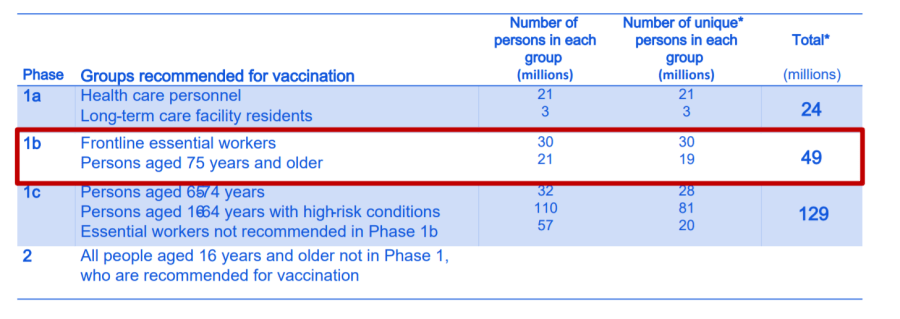
The problem comes once the health care community has been taken care of. What then? Various factions, all with perfectly valid claims, have been coming forward demanding their place at the head of the line. The elderly, who are most susceptible to serious disease and death. Workers in front line non-health care jobs such as food distribution, transportation, and essential retail. Teachers with their exposures to the little disease vectors we call children. Representaives of communities of color who want to redress historic inequities. Over the next couple of months, until supplies can grow to meet demand, it’s going to get ugly as each group and its advocates jockey for position. I do not forsee a nice orderly ‘women and children’ first loading of the lifeboats. There’s one group, of course, that will line jump with impunity and quietly have their needs met: the wealthy and well connected. As much as I have amused myself imagining a line of well heeled Beverly Hills matrons lined up outside of Cedars Sinai, wobbling in their Jimmy Choos and bashing each over their heads with their Jane Birkin bags to be first in the door, we all know that certain lots of vaccine will simply disappear from the supply to reappear in concierge practices and other exclusive care venues not available to the general public. A very telling example happened at my alma mater who decided to give their first shipment of vaccine to their senior executives rather than to the staff actually taking care of Covid patients leading to some very noisy, and well deserved protests and some PR headaches that will take a while to disappear.

Senator Marco Rubio receives his first Covid vaccine


The conservative noise machine now has a problem. On the one hand, they have spent most of the past year minimizing the dangers of Covid and ramping up resistance to basic public health measures that cause little inconvenience. For this reason, we now lead the world in active cases by a long shot and our curve shows no signs of trending downwards. On the other hand, those who are behind the propaganda are not stupid and recognize that it’s their constituency that is most threatened by rampant spread and they are certainly going to protect themselves but have to figure out how to do it without being called out as flagrant hypocrites by both sides. It just makes me angry when I see someone like Marco Rubio, 49 years of age and, to my knowledge, in good health, and who has spent the last year supporting the balderdash coming out of the White House and the even worse behavior of Florida’s governor, getting a dose that should go to someone who is in harms way due to his political stances. Rant over.


I suppose I should say a few things about the latest out of London where there is a new mutation in Covid-19. Viruses of this type mutate all the time and mutate quickly. The current new mutant strain is more infectious than the usual strain and passes more easily from person to person, increasing the R1, the number of new people each case can infect. It does not cause more virulent disease. It will not cause the vaccine to be ineffective. The authorities in the UK and EU are trying to lock down the areas where it is spreading to keep this strain contained because, if it becomes more widespread, the number of active cases , and therefore the number of seriously ill, will increase rapidly and overwhelm what the health system can care for. We may be seeing things like this for a while. Don’t panic. And carry a towel.

Margery Holbourne Saunders Hellmann, Alyn Crandall Duxbury, Alison Beatrix Saunders Duxbury, Alison Jean Maxwell-Wood Saunders and John Bertrand deCusance Morant Saunders – 12/20/1956


Today is December 20th. It would be my parents’ 64th wedding anniversary and it is the first time in nearly two thirds of century that my father does not have my mother in this world to help center and complete him so my thoughts are with him today. I wonder, sometimes, what my mother might have made of this pandemic? She would have taken it in stride. As a child of the Depression and World War II and the daughter of two physicians, she would have worn her mask, kept her distance, washed her hands, and come up with plenty of ways to pass the time when spending the holidays at home. Be like Alison.

December 17, 2020

It’s Thursday night, three weeks after Thanksgiving, and the Covid cases keep surging.  Locally, the state of Alabama is pushing towards 4,300 deaths (out of a population of 4.9 million – nearly one in a thousand and almost certain to pass that mark around the end of the year), UAB hospital, which was handling about a hundred inpatient cases a day prior to the fall surge, is nearing two hundred inpatient cases, and pretty much every hospital in the region is short on ICU beds and on staffing for those beds.  The health care providers of my acquaintance, especially those who work inpatient, are all exhausted and the numbers keep going up.  The transmissions from Thanksgiving travel won’t peak in terms of hospitalization for another few weeks yet, probably sometime around New Years, just in time for the tide of infections linked to holiday get togethers starts to rise. The outlook is pretty bleak until spring.

And here I sit in an emotional state of righteous anger.  I’m sure there’s some perfect Yiddish word for it – all the best words for the peaks and valleys of human feelings seem to be Yiddish (one of my Jewish friends may be able to help me out).  A lot of times when I’ve sat down to right these pieces in recent months, I’ve been sad.  Sometimes I’ve been bemused.  Tonight, I’m just pissed.  It comes from a number of places but mainly out of the sorts of reporting that I have been seeing over the last forty-eight hours.  The news isn’t all bad.  The first people are getting the Pfizer mRNA vaccine, primarily my health care brothers and sisters on the front lines in emergency rooms, Covid wards, and intensive care units. But even that process is causing a certain amount of anger to boil up.

The initial batch of Pfizer vaccine shipped over this past weekend and was more or less set to go early this week.  The storage requirements of super cold freezers able to maintain -80 degrees C have limited where it can go and how it can be distributed.  For instance, the doses UAB received, as it’s the only local hospital with the proper freezers, need to go to people at every hospital system in the region and the logistics of getting them here to get vaccinated is proving quite complicated and requiring a lot of planning and triaging of which health care workers need to be vaccinated first.  This is leading to some sniping between colleagues (I have seen social media posts along the lines of ‘Why did he/she get one before me, he/she only sees patients once a week when I see them every day’) which is unhelpful and uncalled for.  There would be more vaccine to go around but for the ineffectiveness of our current federal government.  Pfizer has new shipments ready to go but, in a press release today, they stated they cannot ship as the federal government has yet to contact them to tell them where to send it.  What????  This is just the first of many things making me blow a gasket or two. 

It struck me as somewhat insane that during a pandemic with the first potentially helpful tool for fighting it available, that the federal government would somehow drop the ball and not think beyond the first shipment.  But then the cynical part of my brain realized that today was also the day that the Moderna mRNA vaccine was considered by the FDA for emergency approval.  It passed committee and, if the process goes like it did last week, will be granted Emergency Authorization for Use tomorrow and ship over the weekend and be available next week.  That would put two very similar competing products in play.  However, the Pfizer product was not part of the administration’s Warp Speed funding and was developed in Germany and Moderna, as an American company, has a lot of very well connected individuals on its board and among its major shareholders who stand to benefit greatly if it gets a greater market share and I can’t help but wonder if the ineffectual distribution of the Pfizer vaccine is deliberate to help that happen.  After it was revealed that Senators Perdue and Loeffler (both trying to retain their seats in the Georgia run offs), used their knowledge to divest travel related stocks and buy stock in companies specializing in body bags, I put nothing past the ruling class and their monetizing of catastrophe.  I can’t find my source on that last one, so someone please fact check me if I’m spreading propaganda.

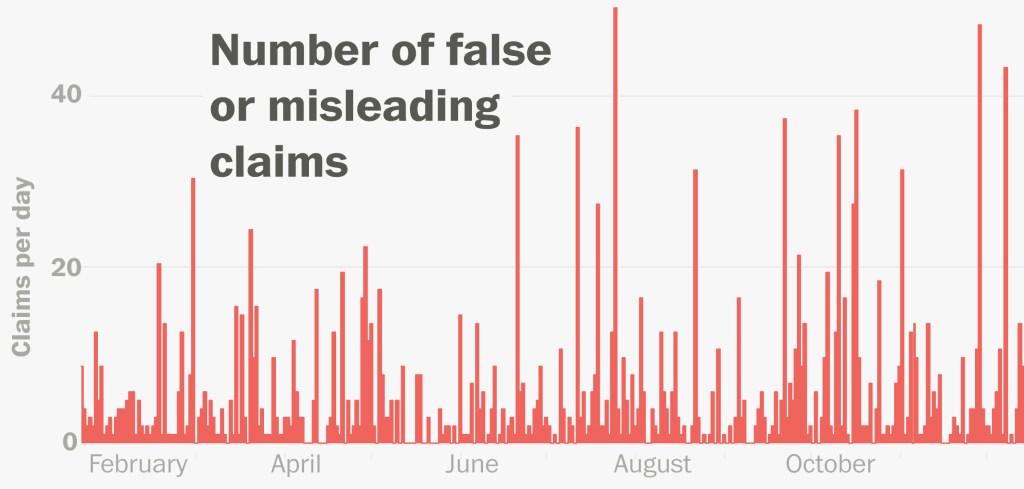
Of course, the thing that I am the most livid about also concerns money.  The communications from this past summer between the White House and the CDC that have been passed along to the press show that when science conflicted with a message of we needed to open for business, the messaging always trumped the science.  Much that we needed to know was suppressed.  There was a very deliberate attempt by the highest levels of the executive branch to institute a policy of infect the entire country for ‘herd immunity’.  There were fundamental misunderstandings of just what herd immunity is and how it actually works but the impression that bursts forth from all of this is a callous disregard for anyone other than the small circles that operate inside the Beltway and they weren’t worried about themselves as, should they happen to fall ill, they would have treatment and support available to them not available to most of the country so their chances of death or disability would be negligible.  The fact that mainly older people were dying was seen as a good thing financially as there are big savings to social programs if you kill off senior citizens. 

It’s time for some quick math here.  The current elder generation becomes eligible for Social Security and Medicare at age 65.  Current life expectancy in the US is roughly 79 years so 14 years total benefit.  The average social security monthly benefit is $1,400.66 per person and the average annual Medicare spending per beneficiary is $10,229.  That comes out to $27,037 a year in federal spending per person on just those two programs, or $378,517 per person over an average life span.  Roughly 60% of fatal Covid cases in the United States are the over 65 group.  To date, there have been 310,434 deaths.  So, the 186,260 deaths of retirees, at $27,037 savings annually, is so far saving 5.036 billion dollars a year in future benefits and somewhere in the neighborhood of $30-40 billion overall.  And we’re adding 300,000 cases and 3,500 deaths on a daily basis (an additional savings of $57 million annually in benefits a day). We haven’t even begun to crest the peak so these numbers, are going to swell significantly.  Don’t think for a minute that every Republican Senator and party consultant hasn’t jotted similar figures on the back of an envelope somewhere.

Generally, when a government asks a people to sacrifice, particularly themselves (such as during war time), there needs to be a thorough airing of the issues at hand and the government needs to get the spirit of the governed behind the policy so that they will be willing to endure the pain of what must be endured for a greater good.  That’s not what we’ve had here.  We’ve had a deliberate campaign of lies, disinformation, suppression of fact, and general bullcrap which has succeeded in splitting the country into two factions, one that is trying to do the right thing by fellow citizens, and one which is living in a state of denial.  Neither side has been given good information by their government so they can come together to make informed choices.  This isn’t the spirit of World War II, this is more akin to the US distributing small pox infected blankets to native tribes – an incident that almost certainly never actually occurred.  However, what we’re experiencing now is all too shockingly real.

December 13, 2020

A truck loaded with the Pfizer-BioNTech COVID-19 vaccine leaves the Pfizer Global Supply Kalamazoo manufacturing plant in Portage, Mich., Sunday, Dec. 13, 2020. (AP Photo/Morry Gash, Pool)

The first trucks loaded with Covid-19 vaccine have left the Pfizer plant in Portage, Michigan and are careening down the nation’s interstates bound for an overly stressed health system.  With the FDA having granted an Emergency Use Authorization, the first shots will be administered tomorrow, predominantly to health care workers on the front lines of caring for victims of the pandemic.  When you think about it, it’s rather astounding that we have come so far, so fast.  The disease was unknown a year ago, was not established in the US until about ten months ago, and only entered most Americans’ awareness about nine months ago.  Generally, it takes a decade or more of meticulous research to create something like this vaccine and it was done in less than a year.  It shows what human beings can do if they band their collective ingenuity together to solve problems in a crisis.  Now if we would just put our minds together and start working on some of the other issues that are tearing our world apart.

There are more than a few myths surrounding the vaccine and what its impact is going to be on the continued battle against Covid-19.  First, it is not a panacea and the pandemic isn’t going to be over and everything isn’t going to return to the way it was next week.  Even if a significant portion of the population is inoculated, the virus is entrenched enough to continue spreading and the basic mitigation measures of masks, hand washing, social distancing, and avoiding of crowds in enclosed space are going to be necessary for a while longer.  What’s ‘a while’?  I don’t know but I suspect that the earliest that these sorts of things will be able to be relaxed is this coming summer and it could be considerably longer than that.   Second, despite propaganda coming out of the current administration, the vaccine has nothing to do with them or their actions.  It was developed by a small German company BioNTech, founded by Turkish immigrants, founded to look at the promising new fields of genetic engineering using mRNA.  Pfizer came on board for upscaling of manufacture and distribution.  Neither company took federal money nor was part of the administration’s much touted ‘Operation Warp Speed’.  Third, it’s not going to be universally available to the general public for quite some time so don’t harass your pharmacist down at the CVS.  The vaccine is under federal control and is being allocated to states based on various criteria such as population, the availability of facilities to safely ship and store the vaccine (which must be kept at super cold temperatures), and disease spread.  Alabama is receiving something like 40,000 doses for a population of nearly five million.

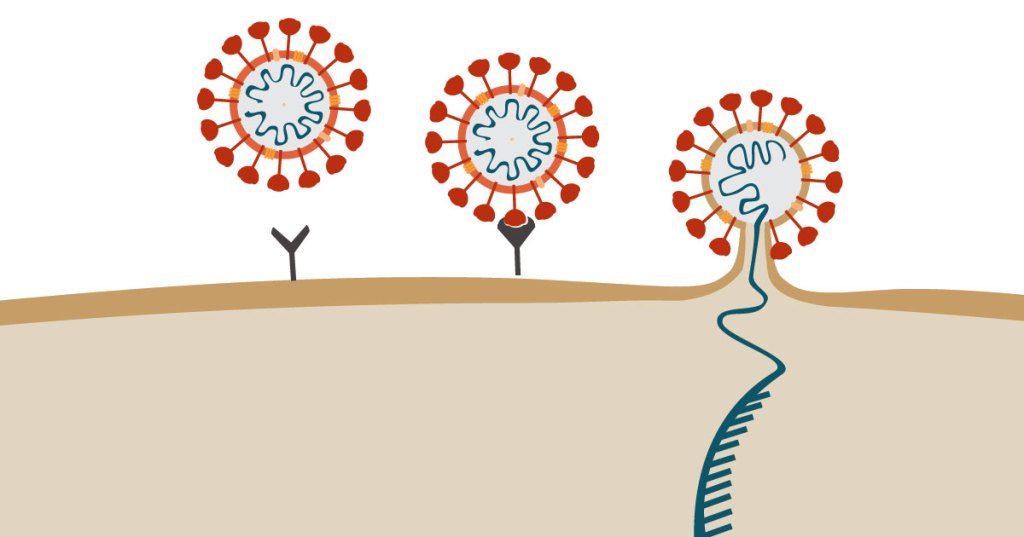
There is trepidation in certain quarters about the new mRNA technology used in the vaccine.  This is a way of introducing small bits of mRNA into human cells and turns their own protein manufacturing abilities into creating antigens which the immune system then builds antibodies to.  It’s a nifty idea, works fine on paper and the studies submitted to the mRNA show good efficacy and minimal side effects.  There are questions as to whether, in certain individuals, this could cause the immune system to react too robustly and make people sicker than the disease would, if the studies really included enough elders with chronic health conditions to know what the vaccine will really do when introduced widely to that population, and if the issues with transport and storage will allow for equitable distribution.  I can’t answer any of these questions at this time and will continue to monitor news and science sources for additional information as it becomes available.  Those I know personally with great experience in infectious disease are saying ‘take the vaccine’ unanimously so I’ll do so when it becomes available to me.  It’s likely to be a condition of continued employment.

My handy dandy coronavirus counter shows that we’re up over 16 million cases in the US.  It only took four days to add the most recent million.  National deaths are at nearly 300,000 and are over 3,000 daily.  Here in Alabama, we’re at over 4,000 deaths and 300,000 cases.  Every hospital in the greater Birmingham area is full.  My colleagues are exhausted.  I received at least one notice daily last week about a long-term patient of mine being admitted with a serious case.  I expect most of them to die. My social media news feed is full of notices of friends asking for thoughts and prayers for their parents, siblings, neighbors, and other connections who have fallen ill. We’re just over two weeks out from Thanksgiving so at the peak for cases fueled by travel and gathering.  The peak for hospitalization hasn’t hit yet and the peak for dying will come sometime after that.  You can gather for Christmas, and continue to contribute to these numbers, or you can come up with some clever alternatives.  The life you save may be your own.  At my house, it’s going to be Zoom Christmas with the family and just me and the cats present in person.

It’s not all doom and gloom at my house.  I’ve had several very productive conversations with a book editor about turning these Accidental Plague Diaries into book form and am diving into that project.  I just wonder if anyone really has any interest in reading it after having lived it.  My Christmas present to myself, a Peloton, has arrived and I am getting in my daily cardio (my primary care physician is thrilled).  I made myself several gallons of mulled cider using Tommy’s recipe that I was actually able to recall from memory and it turned out OK.  For my next trick, I’m going to try Bates Redwine’s and Hal Word’s eggnog using the fifth of Southern Comfort that’s been taking up space at the back of my liquor cabinet for the last decade.  After a dry spell for the last few months, I’m feeling creative again and that usually means something interesting should burst forth.  I don’t know what it is yet, but with luck it’ll help with the trying time we all find ourselves in.

Be safe.  You know what to do.

December 9, 2020

It’s five AM and I’m not going to be able to go back to sleep after sitting bolt upright at four so I might as well do some writing. I was having one of those narrative dreams. I was watching a film (and was also somehow within its world at the same time). It was a generic rom com about a twenty something couple who kept meeting cute and awkward but who were destined for each other. Then, suddenly, there was a hostage situation and a grenade blast and one of them ended up dead and kept trying to reach through and correct things to what might have been. That’s what woke me up. This overwhelming feeling of loss. I think that’s me processing what’s going on in the world in metaphorical terms. At this point, Oliver, one of my two cats heard me stirring and came over and curled up next to me demanding attention. It’s very odd. Oliver has been part of the household since 2008. For the first 12 years he despised any human contact. He would only appear at feeding time and heaven help you if you approached him. Since moving to the condo, he’s a different cat. He wants affection and likes to be in the same room with me. He’ll even share space with his sister, Anastasia which he never used to do. He still vanishes if anyone else enters the condo so he’s not a completely changed feline.


So where are we in terms of the Accidental Plague Diaries? The news isn’t good. The results of Thanksgiving gatherings are beginning to make themselves known. UAB hospital is now running about 170 Covid inpatients. Back in the spring, it was more in the 40-50 range and it peaked out in the summer surge around 100 inpatients on the daily census. And these people are sick. You aren’t being admitted these days unless you’re in danger. Those without significant oxygenation problems or other complications are sent home to recover on their own. We’re at a bit over 15 million cases in the US which means we’re adding nearly a million and a half cases a week. The daily death toll in the country is hovering between 2500 and 3000 which is between a Pearl Harbor and a 9/11 occurring on a daily basis. I expect in the next couple of weeks, with more holidays coming, it will surpass 3000 a day and we’re likely to see 100,000 deaths a month in January and February.


Each one of those people was someone who was alive and looking forward to the holiday season a year ago. They were parents, children, siblings, spouses, friends. They had no idea that 2019 was going to be their last chance to celebrate with those they loved. 286,000 to date – roughly the population of Orlando, Florida. Most of them would still be living if we had a federal government capable of functioning and meeting challenges head on. Perhaps we will have that again, perhaps not. We’ll find out shortly. I’ve lost a number of patients. The story is usually the same. Younger family members who have not been as careful as they could be come to visit and bring an unwanted house guest and an elder pays the ultimate price. As a society, we tend to heave a collective sigh of ‘so what, they were old’. But I can tell you from thirty years of experience in geriatrics that most of our elders have a lot to give and teach us all about the human condition and who we are as people.


It wasn’t so long ago that a well respected senior physician from a surgical specialty was talking to me at a social event and said to me ‘You’re so bright. Why did you waste your career by choosing geriatrics?’ I’ve had a lot of successful academic physicians say things like this to me over the years. Usually it’s not quite so blunt and couched in more politically palatable terms but the end message is the same and unmistakable – taking care of the elderly is somehow for losers. I obviously don’t think so or I wouldn’t have chosen the field. Actually, I think it’s more that the field chose me. Most who go into geriatrics do it based on some life experience with an elder – a grandparent or great grandparent. It didn’t happen that way for me at all. Like most things in my life, there was a great deal of accident and serendipity.


I chose internal medicine as my specialty coming out of medical school because I didn’t know what I wanted to be when I grew up. Internal Medicine seemed to be the best way to delay that choice. I knew I wanted some sort of rigorous academic training. Having grown up in an academic family, I understood innately how that world works and felt comfortable with it. Off I went to my residency in Sacramento at UC Davis with only a vague understanding of what I was getting myself into. I did my residency in the late 1980s – a different world than today. It was before national legislation regarding work hours went into effect and you were expected to work until your job was done, which was generally an 80-90 hour week. You were on call in the hospital every third or fourth night with no guarantee of sleep. Six months into my first year, the dreaded internship, I was sleep deprived, lonely, miserable, and wondering if I’d made a huge mistake. (Pretty common feelings among all of us). Then things started to get better: I met Steve. I came out and began to live a more authentic life. I finished the intern year and schedules got easier. (To this day, most of that intern year has been erased from my memory – not enough sleep…) I got the hang of how to do my job in residency and do it well.


Half way through my third year, my program director had her quarterly meeting with me and looked at me and reminded me that there was no fourth year on the program and I had better figure out what I wanted to do with myself. That pulled me up a bit short until she told me ‘Go home and figure out who you are, and then you will know what you should do’. So I went home and talked to Steve about things and realized that I enjoyed ambulatory care, liked talking to patients, believed more in health than in disease and liked working collaboratively in teams. That made it obvious, I needed to receive my advanced training in academic general internal medicine and off I went to talk to the head of that division who welcomed me and offered my a fellowship with them to train to become clinical faculty. On my way out the door, he mentioned the geriatrics fellowship they also offered and which no one ever wanted to do.


Here I am, seven years into medical training and I have never met a geriatrician but I am quite capable of reading demographic charts so I thought it might be a good idea to see what was happening in the area. It didn’t take me long to figure out that this was a group of people who thought about medicine in the same ways I did so I signed for geriatrics training, not out of a specific wish to treat the elderly, but out of a specific philosophy of how I could create and mold systems of care that would be good for all people, just using an elder population in which to do it. I have always believed that what I do as a doctor is what is good for human beings in general. I just happen to do it for the elderly as the system will begrudgingly allow me to take the time necessary and utilize complementary resources such as nursing, therapies, and social work rather than insist on my getting a patient in and out the door every fifteen minutes.


The health system, in general, understands that geriatric care is important as most of their client base is aging and Medicare is often their largest payor source. However, it has a very tough time understanding the role of geriatrics. Our system is built on specialization, a breaking down of a human being into organ systems or even further into basic biochemical and physiologic components. You achieve success in the system by becoming a subspecialist. You achieve great success in the academic world (even as a geriatrician) by becoming a leading expert in a very narrow area. As the system hums along and creates new doctors, there is an implicit bias against general thinking in favor of specialty thinking. Bright candidates are steered toward narrow subspecialties, especially if they involve procedures (highly compensated) versus what are known as evaluation and management (E and M) services which involve thinking and listening and chart research to achieve a diagnosis. If I had a nickel for every time I’ve heard an attending physician tell a promising medical student a variation on ‘you’re too good for primary care’, I’d be a very rich man. There’s an interesting tangent as to why this attitude exists. Procedures are easy to quantify. You can describe them in exact terms. You can distinguish one from another easily. It’s not too difficult to understand what level of expertise, what sorts of ancillary services, and what equipment are needed for each one. E and M services, on the other hand, are very vague. If I am seeing an older person with memory problems trying to distinguish dementia from normal aging change, I do no biopsies, I rely on my experience, intuition, interviewing skills, and simple paper and pencil tests. I will do some lab work and a brain MRI if I am concerned about an interfering undiagnosed medical condition. All of that can take me well over an hour. We are reimbursed by Medicare (and most other insurances) by submitting bills coded through a system known as the CPT. There are thousands and thousands of codes for procedures but only a handful for E and M services. These codes are proprietary (put out by the AMA) and the committees that create the coding systems consist almost entirely of subspecialists eager to show their worth but who have grave difficulty with the expansive thinking of someone like me who thinks backward from their coning down process. Consequently, those of us in cognitive specialties tend to be paid at much lower rates.


This has, over the decades, led to a bit of a crisis in geriatric care. The number of board certified geriatricians in the country topped out at around 9,000 in the 1990s. Most of these took the test without formal training through a grandfathering process. Many of those chose not to recertify or were older and have since retired so the number of geriatricians currently is closer to 6,000. (It’s been estimated that we need about 30,000 to care for the aging baby boom, who start turning 75 next month). There used to be about 800 training slots for geriatrics in the country. Due to lack of interest from medical students and residents, many of them have closed. There are now about 400. Only 200 individuals applied for the training programs this past year. UAB, a major university with an excellent training program and track record has now been unable to attract any trainees in geriatrics for three years running. Those who come up through our medical programs, like most young people, head for brighter lights and bigger cities.


There’s been a surge in applications to medical school this last year (up 18%) – which some have dubbed the Fauci effect. I think that’s wonderful but those applying this year will not graduate Medical school until 2025 and residency until 2028. So even if some of them choose geriatrics, and I expect we’re going to see a huge surge of infectious disease specialists before that, they’re not going to be ready until about 2030, the year the very last boomers pass 65 with the leading edge bumping against 85- less functional and with chronic disease burden, but not yet into their die off, in other words, peak age. Every demographer has been pointing out this phenomenon since the 1970s but no one has been listening. My planned retirement date is somewhat before this. It’s going to be someone else’s problem.


The cynical piece of me can’t help but wonder if there’s someone sitting in the offices of the Center for Medicare and Medicaid Services running spreadsheets of data and calculating what percentage of the boom needs to die of Covid over the next few years to reduce tax dollars flowing to the health care sector over the 2020s and 2030s. I hate to think of it but I put nothing past the current administration. Don’t be a statistic they can use: wash your hands, wear your mask, social distance. You know the drill.

December 6, 2020

The Lakeside School – one of the things that made me who I am

Today is the last of my days off before heading back to the salt mines of geriatric health care again tomorrow. They weren’t anything like I expected them to be when I initially scheduled them back in the late summer. At that point, with Covid-19 on the wane, I assumed I would have some days in Seattle with my family and some days taking myself to the beach or somewhere scenic. Given the skyrocketing numbers of infections throughout November, those plans all went out the window and I spent the majority of the last two weeks puttering around my condo working on various projects and taking naps of various lengths. If I sat on the couch or the bed for more than about ten minutes, out I went for anywhere from 15 minutes to two hours. I’m not usually a napper so I’m assuming my body and brain are working a program of resetting and energy storage to be ready for what’s going to come over the next few months as cases engulf the health care system. I may not work directly on Covid wards but the huge increase in hospitalizations has downstream effects on all of us, no matter what our roles in the system may be.


When I fell into writing these entries nine months ago, I had no idea what I was doing. I was as unprepared for what was to happen as the rest of us. As I began to figure that out and tried to puzzle through what was happening for myself, I found that more and more of my friends were turning to what I had to say about all of this as a place of stability and rationality in volatile times. I figured out that these bursts of text were helpful to a wide community of people and were making their way to folk that I have never had the pleasure of meeting. This brought me up a bit short as I realized I had better make sure that I was clear about what was fact, what was opinion, and what was just random musings. I hope I’ve been able to do that as I don’t want people making important decisions based off of anything other than good science, unlike a number of politicians I could name.


There’s a part of me that wonders if I was born for this particular moment in history. If there’s something unique about my experiences that allows me to put all of these ideas with a certain candor and clarity that others might not be able to do so easily. There are certainly a number of traits that have collided. The first and most obvious being my medical training. There is a strong tradition of medicine on my mother’s side of the family. Both of her parents were physicians. My grandfather was an orthopedist and anatomist, later dean of the medical school and then chancellor at UCSF. My grandmother was a pediatrician. My grandfather’s father was a physician in Scotland and later in colonial South Africa. There was a certain expectation in someone in my generation of the family going to medical school and I was the one best suited. I was nudged toward the sciences in high school, majored in Chemistry and in Biology at Stanford (they didn’t have a Biochemistry major so I decided to just do both…), and entered medical school at the University of Washington in 1984.


At that time, one of the serendipitous chances that have marked my life happened. I was placed in the WAMI program – Alaska, Montana and Idaho did not have state medical schools but sent their residents to U of W as ‘in state’ but required them to spend their first year in their home state and to return to rural hospitals in their clinical rotations to continue to increase their ties with their home states and create a cadre of physicians who would serve those states after training. Washington participated as well and I was placed in that program and sent away from Seattle to WSU in Pullman for my first year and then off to various destinations in the other states for clinicals. By the time I graduated, I had rotated through fourteen hospitals in four states: University medical centers, VA hospitals, large community hospitals, small rural hospitals. The end result was that I was comfortable in a wide array of settings and I found that I really enjoyed working in smaller venues where physicians were much more a part of the community at large and not removed from the lives of their patients.

UC Davis Medical Center – a building I will never enter again – but that’s another story


Serendipity and the residency match system sent me to UC Davis in Sacramento after medical school where a number of things happened very quickly. One, I met Steve, came out of the closet and started to live an authentic life. Two, my original idea of using medicine as a springboard into a research career in occupational medicine (born of summer jobs working with hazardous waste) was quickly knocked off the life goals list. Three, I came to realize that I was a lot better at ambulatory medicine than hospital medicine. Four, my ideas of how a physician should function as a member of a community, intimately familiar with human ecology and the lives of their patients found a home in geriatric medicine, a field that I had never been introduced to in training. With the choice of geriatrics settled, my interest and comfort with ambulatory care, especially in smaller communities led to my learning quickly about home health, house calls, case management programs, and other such animals, something completely alien to most physicians who leave what happens outside of the hospital to nursing, social services and discharge planning.


My education is broad based. I was fortunate enough to attend a very good college prep school for high school and a top tier university. I don’t know that the classes I got at either of those places were better or worse than ones I would have gotten anywhere else but it did put me among a peer group that required full throttle thinking in order to stay caught up and engaged. I was also determined to take advantage of the opportunities provided and took at least one class a quarter that was something different just because I could – Japanese Religion, Introductory German, History of the Roman Empire, Modern Philosophy, Music Theory I, Computer Programming in PASCAL, Introduction to Petroleum Engineering. Add this to growing up in an academic household and a mother who was basically brought up in a British household (and gave me all the British classics to read at a young age), and I emerged as a bit of a polymath. My college roommate once gave me a T-shirt that read ‘The Expert on Everything’.

Lastly, I am a gay man of the tail end of the generation that was wiped out by the HIV pandemic. I spent the early 1980s in the San Francisco Bay Area and saw first hand how my peers began to languish and die. By the time I hit clinical medical training, the virus was raging and I sat by the bedside of many young men, only a few years older than I and held their hands while they died as there was no one else to do so. I began to understand that the US government and society is perfectly fine with large swaths of its citizenry dying as long as they can define the victims as ‘other’ in some way. And I saw and was part of a gay community that rallied and built the institutions to take care of our own when help was not forthcoming. The thing about being a gay man of my age is that the group of men who would have been my mentors and guides and helped me with life and career for the most part ceased to exist leaving me to have to forge ahead without a lot of guideposts. I’ve come out OK but I made some huge mistakes along the way which might have been avoided with the availability of counsel.


Putting that all together: a broad based understanding of many subjects, the trained mind of a physician, the use of that mind to find new ways to work in collaborative structures for better patient care, especially for underserved communities, a realization of how government and society are not there for us the way we think they are, and some communication skills picked up along the way through my theater endeavors, plus a dollop of loneliness and needing to connect due to life circumstances, and you have how and why I write these pieces. How could I not write them? All I wish at this point is that I could offer better news about the progress of the current pandemic but, alas, that’s not possible. The numbers look bleak and we’re only starting to see the effects of Thanksgiving travel now. Hang on. It’s going to be a rocky road but there are chances to change course upcoming, especially after mid-January.

December 3, 2020

Stress Testing in an Engineering Lab

I was going to write my next update in these Accidental Plague Diaries tomorrow but I woke up this morning with a feeling that I better write today and generally, when I have one of those moments, there’s something in the recesses of my brain trying to burst out and the best thing that I can do is just start typing away until my limbic system (or is it my frontal lobe?) says enough, you’re done and generally I feel a bit better in general. I don’t feel bad today. I’ve been a bit lazy the last couple of days. I’ve made starts on my next round of home projects but I haven’t put in the hours and hours that they’re going to need. Instead, I have spent time in reading junk novels, doing a jigsaw puzzle with far too many monochrome pieces, and assembling the holiday gift basket for my family in Seattle and hauling it off to the UPS store for shipping.


I think the thing that has me screaming inside is the incredible escalation of Covid numbers over the last few weeks which has been met by a collective shrug by our government and with society as a whole as the latest shenanigans of various Republican lawyers try to overturn the presidential election without a shred of objective evidence and the financial chicanery of the presidential fund raising apparatus, busy fleecing the flock with The Grift of the MAGA, push other stories off of the front pages. We are now at 14 million cases of Covid. There were 9 million at Halloween, less than 5 weeks ago which means we are adding 1 million cases a week. We now have over 100,000 people hospitalized nationally which is more or less the inflection point for national systemic strain and that number is going up. Roughly 2800 people died yesterday alone. That’s more than were killed at the World Trade Center on 9/11. In two days, we are losing more citizens than China, with its 1.3 billion people, has lost since the beginning of the pandemic. Their official total death toll since last December is fewer than 5,000.

Indian elementary school in the time of Covid


I expect these numbers, which are horrific, are going to take a sharp increase over December as we have yet to see the impact of the Thanksgiving holidays. Cases caught over the holiday weekend won’t start showing up in hospitals for another two or three weeks; just in time for everyone to start gathering for Christmas, New Years, and other end of the year festivals. The level of societal denial that’s going on at the moment is breathtaking. I woke this morning to news that one of our ritzier suburbs is planning on a huge holiday party/dance for the middle schoolers at a local country club. Just what in heaven makes people think putting 500 tweens in a ballroom midwinter bouncing around to the latest hits is a good idea? I understand parents wanting to provide some normal socialization but these are not normal times. A recent study from India (which has a different culture so you can’t just generalize) which involved hundreds of thousands of cases and contract tracing showed that the major vector of spread was schools. Children are walking petri dishes for viral illness. They always have been. It’s part of the necessary process of developing a healthy body. Put them together in enclosed space, and then have them mingle with children’s normal behaviors and they’re going to trade germs like crazy and then carry them back home.


We’ve reached the point where Covid is becoming a significant stress test on our societal systems. I view it sort of like when structural engineers test models in wind tunnels to determine what sorts of architecture can withstand a category 5 hurricane. We’re putting societal infrastructure, which has been deliberately hollowed out by various decisions over the last fifty years, out there and subjecting it to a simultaneous 8 on the Richter scale earthquake, F-5 tornado, and wildfire storm. It’s no wonder things aren’t doing so well.


The piece of society I am the most familiar with is the healthcare system. What was once the most advanced health culture and the envy of the world in the decades following World War II was changed from a system whose goal was improving American lives to an industry whose goal was improving American businesses bottom lines, executive compensation, and stock profits. It wasn’t deliberate, no one person or thing orchestrated it, but starting in the mid-70s, the sector was taken over by business minds focused on the manufacture of health as measured in data points and the system was stripped of excess capacity in order to make it lean and mean. Physicians and others skilled in healing lost control of the system to those with skills in accountancy, marketing, and data management. This has all coincided with my career in medicine (I having entered the training in 1984) and its been both fascinating and nerve wracking to watch all of this happen. With the stress of Covid out of control, we don’t have hospital capacity, we don’t have staff capacity, decisions are made based on financial risks to institutions, we continue to lose smaller and rural hospitals, especially in states which refused the Medicaid expansion for political reasons (many of these the same states in which the infection is spreading like wildfire as the same political trends push the population to ignore sound public health advice). My generation of physicians is getting pummeled and fed up and will likely begin retiring at a relatively young age. I don’t see many of us working into our 80s in the way that an earlier generation did. And we aren’t going to have a new generation to replace us as the system pushes graduates into specialties of high remuneration rather than of societal need. We haven’t been able to attract a single fellow for training in geriatrics at UAB for three years.
The hollowed out educational system is hurting. Teachers were having to make do with significant funding cuts as back as far as the Reagan era and with salaries so low that many work second jobs to make ends meet. The move from having teachers teach to manage data metrics and preparing students for standardized tests which came from the No Child Left Behind act, caused another huge issue. Now teachers are being asked to work two full time jobs. As in person classroom teachers and as on line teachers to students whose families have opted to keep their children out of the classroom due to Covid risks. It can’t be borne and the older generation will retire and the younger generation will burn out. The lack of leadership from the current administration’s Department of Education, run by someone whose sole qualification was donating huge amounts of money to right wing causes, is just the icing on the cake.


What can I say about our government? On the federal level, the executive branch decided to politicize a worldwide pandemic into an us vs them exercise, spending months feeding misinformation to the public about risk, public health measures, and basic scientific laws. When the pandemic blossomed out of control, which was inevitable in the face of this attitude, they simply ignored it, kicking responsibility to the states with the results that more conservative states, following federal example, chose to act as if nothing was happening and poured even more gasoline on the fire. State governments, with the exception of a few large rich states such as California and New York do not have the resources to deal with world problems. It is the role of federal government. Things may begin to change on January 20th but that’s still seven weeks away. In the meantime, at current trends, another 7 or 8 million people will get sick and another 350,000 will die.


So keep up the good fight, wear your mask, wash your hands, social distance and stay out of crowds.

November 30, 2020

And the long holiday weekend is over. All of the people who traveled against CDC advice have traveled again to get themselves back home and the numbers continue to mount. I canceled my personal travel plans when the numbers really began to skyrocket in early November. I’m fairly savvy and could have made the trip to Seattle and back safely but the odds for such things are tipping away and don’t look good to me until numbers start decreasing again and I don’t think we’re going to see that until Spring given that the weather will drive us all back indoors. We’re having an unseasonable cold snap here in Alabama at the moment with a light dusting of snow here in Birmingham. This is not conducive to outdoor activity. I was going to take a walk earlier but the weather was really too ugly.


In terms of judging risk, not just from Covid but from all other activities of life, I apply the car test. If, as an American, you get into a car with any regularity, your chance of dying as a result of a car accident in any given year is 0.02%. It’s pretty low so the risk benefit calculation to most of us is pretty easy so we all get into our cars without thinking about it. Now let’s compare that to the risk of death from Covid which seems to be somewhere between 0.6% and 2% for all comers and is even higher for my gender and age group. In other words, about 100 times as dangerous as driving. That starts to give me pause. When evaluating risk, if it’s less risky then driving (flying, being struck by lightning, being attacked by a shark at the beach), I never worry about it. If it’s orders of magnitude more risky, it gives me pause. Seattle will still be there in a few months and hopefully, when spring comes, risks will start descending as human activity again starts to move outdoors, and, with luck, we have a vaccine that should provide at least partial protection and an executive administration guided by science rather than by political whims.


I don’t have much new to report on the vaccine front. The Moderna mRNA vaccine I wrote about in the last few entries was presented to the FDA for an emergency use authorization so we should hear about approvals for it and Pfizer’s similar vaccine in the next few weeks. There are still a lot of questions about distribution to be answered. The last thing I saw was that the federal government was going to distribute it to the states based on population and then let the states decide for themselves how to allocate it from there. While this fits in with the administration’s passing the buck and every state for itself strategies, I don’t think this is the wisest of ideas as it gives no flexibility to distribute vaccine based on hot spots or needs. The Dakotas, for instance, are in serious trouble but with their relatively small population, vaccine just isn’t going to get there.


The hot off the presses news from today is that Scott Atlas MD, the Stanford radiologist with no epidemiological or virology experience who was appointed to be a senior adviser to the president’s Covid task force has resigned. Good! His blase laissez-faire attitude toward prevention have likely cost thousands of people their lives. As I still have an active California medical license (I kept it because for years I assumed I would go back – that’s not going to happen and I now keep it out of habit), I seriously thought about calling up the Medical Board of California and filing a complaint against him for endangerment. I am counting the days until January 20th when, with a little luck, decisions on the national level will once again be based in sound science and public health. We’re at 13.5 million cases in the US as we head into December. A month ago we were at 9 million. One third of all Covid cases since the beginning of the pandemic have happened in the last month.


I have this week off. My Christmas preparations are pretty much complete so I have to find something else to fill the time. The next big thing on my to do list is to go through the bins of ephemera that came out of the house in the move. I’m a pack rat. I keep letters, theater programs, photographs, news clippings: anything that I think I might like to look at again. I used to be very good about scrapbooking it all but that kind of fell by the wayside with Tommy as he, unlike Steve, had no interest in that kind of sentimentality. Now I have what feels like a few metric tons that I have to go through and decide what to save and what to discard. I’ve been putting this chore off for a while because its going to cause me to go through a lot of memories of togetherness at a time when I’m isolated and alone. It would be easier to do with someone so I could reminisce and tell the stories but that’s not really possible at the moment. I’ll probably dance around it for another day or two and then just sit down and start. That’s my usual modus operandi. If I find anything terribly interesting, I may scan it in and share it with y’all. Pictures of a time when I had a hair color…


Stay safe, stay well, and be careful out there.

November 26, 2020

Happy Thanksgiving everyone. Time for another essay length post about life, the universe and everything. I haven’t the vaguest idea what I’m actually going to cover today – sometimes my best creations fashion themselves by my turning my conscious mind off and just letting the fingers fly across the keyboard. It is turkey day. No turkey here. I was hardly going to cook a turkey for one for dinner. I do have a few goodies in the fridge for later along with a bottle of wine for our family zoom hour coming up later this evening. Family stretched across four time zones and alcohol will either end up in hilarity or disaster. Knowing my people the way I do, it will almost certainly be the former.
As much as I kvetch while writing these missives, I really do have a good deal to be thankful for. I have a roof over my head. I don’t need to worry about where my next meal is coming from. I remain gainfully employed with a regular paycheck. My needs are all met. I can satisfy most of my wants. The two that I cannot, theater and travel, are denied to pretty much everyone at the moment so I can’t whine about it too much. Covid will continue to run our lives for a while longer but eventually we will adapt to a world wherein it exists and we will all figure out how to do those sorts of things in manners which allow us to be safe.


There’s a couple of new wrinkles on the vaccine front that I’ve learned about in the four days since writing the last one of these diaries (which shows just how quickly things are moving). The first is that there is another vaccine that has emerged with a successful track record. This one, from Astra-Zeneca and the Jenner Vaccine Institute at Oxford University, is very different from the two mRNA vaccines I discussed previously. It is a live virus vaccine and, because of this, it does not have to be kept at super cold temperatures for shipment and storage. It is stable at room temperatures for some time making it easier to distribute, especially to parts of the world that have less developed infrastructure. It is also, due to funding promises from various sources, likely to be a good deal cheaper than the mRNA vaccines.


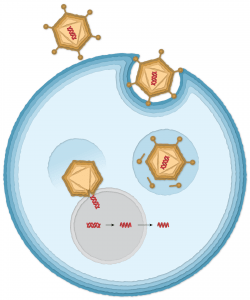
This vaccine has its roots in the Ebola and MERS (Middle East Respiratory Syndrome) outbreaks of the last decade. Knowing that there would eventually be a world wide pandemic of something, scientists at the Jenner Vaccine Institute decided that what was needed was a vaccine that could be easily modified for any particular disease that came down the pike. They took a cold virus (an adenovirus to be specific) from chimpanzees, modified it slightly to make in uninfectious to humans, and then started to work out ways that it could be a messenger and drop any particular engineered payload to human cells, allowing the immune system to activate against it. They were quite far along with their ideas when Covid hit and were able to pivot to using the spike proteins of the coronavirus as the target, more or less completing ten years worth of work in less than ten months. The original trials of dosing of this vaccine weren’t especially promising, 50% protection rather than the 95% of the mRNA vaccines until there was a happy accident and, by error, one of the test cohorts got only a half dose in their initial shot of a two shot series. Those individuals showed 90% protection. No one’s quite sure why but the studies are being hurriedly looked at and replicated.


So there now appears to be a bit of a three way horse race to see who can first get an FDA emergency use authorization and then get their product out. I’m thinking Moderna is likely to be the winner here. It comes down to money. The Pfizer vaccine is backed primarily by Germany and the Astra-Zeneca is backed primarily by England while the Moderna is American. It doesn’t hurt that Moncef Slaoui, the vaccine guru behind ‘Operation Warp Speed’ was on the board of Moderna and was reaping benefits from the company until Elizabeth Warren pointed it out and pushed for him to divest. I have a feeling that a number of individuals well connected to Moderna are going to make a killing over the next six months and there will be a lot of mutual back scratching along with the congratulations. Societal upheaval and disaster has always created new wealth – like Procter and Gamble moving from local Cincinnati company to international powerhouse on the strength of contracts to supply the Union Army with soap and candles. Perhaps Honore de Balzac had it best with his quote ‘Behind every great fortune is a crime’.


Numbers are continuing to skyrocket everywhere and will continue to do so while we have rules and regulations governed more by politics and judicial fiat than by sound public health principles. We’re just lucky that the mortality is as low as it is. If this were SARS (and technically Covid is SARS-2) with its 15% mortality rate, we’d have nearly two million dead at this point in the pandemic and our social and health institutions might be close to a state of collapse. Y’all know what to do. Wash your hands, wear your mask, social distance, stay out of crowded buildings if you don’t have to be there. I hate to think what the numbers are going to look like at Christmas given the widespread flouting of these simple rules that continues to go on. I’m tired of hearing about people I know and love falling ill or losing loved ones.